Tuesday, April 16, 2013
A Good Day
Alas, I still have no camera, but I hope to remedy that before we embark on our Spring Break trip at the end of this week. We are going to Bumthang, to the east of us, and I am really excited about it! You will have to bear with me with this post, first because I don't have pictures to add to it at this time, and secondly because it is going to break the rule of being in chronological order. I promise I'll post at an upcoming date about our trip to the Paro Tsechu festival and our camping adventures by the hot springs in Gasa, and our recent encounters with the King and Queen! I know, it's a cliffhanger, but I hope you'll stick around and not be too bothered by the out of sequence story-telling.
I am doing this because I positively must tell you about today before the magic of it seeps into the rest of the days here and I neglect to tell about it in its own marvelous singularity of one wonderful experience among many.
This week is midterms, meaning regular classes are canceled in order to make the scheduling of the exams function smoothly. This also means that I have had more time to put in extra hours at my internship at the National Biodiversity Centre (NBC). Today, this was especially excellent. Most days when I have work in the mornings, I have to hurry on my way back in order to make it to class on time. My route to and from work is about a 40 minute walk, first down through campus from my dorm to a shortcut through some of the staff housing neighboring campus. Then, after cutting through a gap in the fence by their houses, it is down a narrow horse/goat/person path that follows the ravine of the river through the woods, with the river to my right and the apple orchard uphill to my left. After many minutes this way, I meet up again with the dirt road, pass a farm where the dogs are sometimes very scary and I must walk very slowly, up the hill for a half mile or so, and then up and down along the paved road for another mile or so until I get to the NBC.
So far, at work, my task has been to examine the preserved plant specimens in the Herbarium and to transfer all of the information on the specimen sheets into digital files so that we can analyze them later. The NBC is particularly interested in mapping where the specimens have been collected in order to assess how thorough the collections have been so far. For now, we have to do all the data entry first, though and then we can begin the analysis and get into the related projects. Even though this is a little tedious at times, and the Herbarium reeks of camphor (they use mothballs as part of the preservation process), I have been learning all kinds of plant names and characteristics. Some of the specimens are very old, as early as 1914, but some are very recent: 2011. As I work, I really like to imagine what the collection teams were doing and seeing and feeling as they collected the specimens. How did they choose this particular sample? What brought them to this valley, or this riverside, or this garden? What did is smell like being next to this tree when it was in bloom? Was it hard to collect this one with all its thorns? What was the view like at 4300 meters where they found this shrub? How did this team get the task of collecting these plants?
It is a lot to think about, and it makes the work fun. But, I'd like to focus now on what happened after work today. Since I had extra time, and felt especially spirited while walking back, I decided not to take the path by the river up toward campus. A few days ago, I had overheard someone talking about a way to cut through the orchard, and I wanted to try this out. Feeling a tad sneaky, I found a small path leading from the road into the woods beside the orchard. This was a very good decision.
I went out of sight of the road and changed from my kira into western clothes, knowing that during this walk I might go through some brambles, and I wouldn't want to snag the beautiful fabric of my kira. Once I had changed, I made my first exciting discovery of the day. Just as I looked up, there was a giant exoskeleton of some grasshopper-like insect still clinging to the trunk of a tree. It was a pale gold color, and still in perfect replication of the creature's body. I admired it for a few moments, then zipped up my pack and went on my way through a gap in the barbed wire fence had been knocked down.
The apple trees of the orchard are all in bloom right now, and the pink blossoms radiate an intoxicatingly sweet scent, giving a luxurious hint at the fruit to come later in the season. I took many nose-fuls as I walked through the haphazard rows of trees, following the paths where the grass had been trampled low. I slowly made my way uphill in the direction of campus, often stopping to admire a low-lying flower I would nearly fail to notice. Primula, dandelions, and what I believe are wild strawberries poked through the thistle and grass here and there. I also found some sage, and gathered a few leaves that I hope to dry. I may try to do some pressed flowers and herbs while I am here.
As I walked through, investigating some insect-eaten stumps as I went, I tried to keep my ears open for birds or other critters. This was hard to do, as I was making a lot of crunching and crackling noises as I went through the long blades of dry grass. Some areas had very short, lush grass though, and I was able to be quieter there. I tried to move even slower and more cautiously, but I still heard crunching, and when I made my way around a little bend toward the next level of the orchard, I found someone I should have certainly expected to see, but hadn't considered at all. To be honest, it was actually two someones, enjoying a meal in the orchard. Cows!
One smaller brown cow and one enormous black cow ripping away and chewing up the grass very selectively. As I have made a custom of doing when I come upon animals, I put out my arms and made a deep bow. I'm not sure what the animals think of this. I think the giving up of eye contact means something to them, but at the least, the cows didn't seem to mind, and they permitted me to come and sit below an apple tree near them. The big one paid me very little mind, but the small one gave me many wary looks. I put down my pack and took off my shoes and sat cross-legged under the tree, looking at the blooming trees around me, and taking care to situate myself so that I was facing the same direction as the large golden statue of Buddha on the next mountain down the Ngabiphu valley. I don't know if that has any significance, but it felt right. I watched the clouds look like they were going to gather thicker, and possibly rain. I watched the ants and hoped they wouldn't crawl into my pants. I tried to get in the meditation pose I had learned from Lama Shenphen last week, focus loosely on a clump of grass in front of me, listen to the river as it whooshed down the ravine, and think about my breathing.
I couldn't seem to get into the mood of mediation, so I gave it up for the time and thought about the wonderful things I'd already seen today, and that I liked how fresh air and cows smell.
I got comfortable and watched the cows eat for a long time. The small one had a really funny way of wrapping her tongue around the end of a branch and snapping off a bud, and letting it crack and crunch between her teeth. Both cows were tethered to a tree by a rope tied around their horns, so they only had a certain circle of motion, but the big one came right up near me. She was taller than I was, even if I were standing, with a muscularly broad body, and full, drooping udders. Eventually, I decided I should get up, and I did. As I was going away, I gathered up a handful of grass and approached the small cow, who had stayed in the same small area since I'd arrived. Now, she had lain down, but I went toward her with my offering of food, no better than what she could reach herself. She sniffed it and turned away, so I put it down, but in doing so, noticed that her tether was tangled in the branches of the shrub she laid beside. I worked at the rope for a minute, untangling it and putting the slack near her so she could see it. As I walked slowly past her to go, I paused and put out my hand for her to smell again. She put out her long brown tongue and gave me a rough and very wet lick. I smiled, and went on my way.
A few weeks back, my best friend Emily Baldwin sent me this link about the importance of nature and wild places. The author used one quote from Willa Cather that I positively loved. It was to "know what it is to be 'something that lay under the sun and felt it, like the pumpkins.'"
I am wishing all the grasshopper, apple, cow, and pumpkin-hood in the world to you.
Much love,
Carrie

Monday, April 1, 2013
Life in Ngabiphu
The moon is starting to wane back toward a crescent, marking just over a
month that I have been in Bhutan! I am getting used to daily life here, but it
is still much to adjust to; either way I would like to share some of these
details with you.
RTC is located in Ngabiphu in the district of Thimphu, about a 25 minute bus
ride from the city center. We are up on a big hill which just leads up to
bigger hills and mountains all around. The campus is surrounded by forest, with
a rocky stream leading along one side. During the day it gets quite warm, but
nights are cold, and I am grateful that my roommates have a space heater in our
room. Buildings don't typically have heat, and classes are often requested to
be held outside in the sunshine where it is significantly warmer. There are a
bunch of quirks about ordinary things like doors and bathrooms. For instance:
there are no doorknobs, anywhere. Everything is closed with latches, making it
extremely possible to be locked into your room via the inaccessible padlock
latched on the other side. Luckily for me, I am on the first floor, but it's
really just a matter of knowing if your roommates are in the room or nearby. I
have two roommates: Kunzang and Tiger. My first impression of them was that
they were far too cool for me, but we get along really well and they are always
very generous with food and cookies and help me out when I need help with my
kira. I try to be generous too. Sharing is somewhat inherent in the lifestyle
here, while saving stuff for later is not.
The set-up of the Wheaton in Bhutan program is that I am enrolled in three courses at the Royal Thimphu College (RTC) and participate in an internship/practicum in addition. Two of the courses are taught by our Professor Owens, the director of the program this semester who is our teacher and group leader; these are the classes I take with the ten other Wheaton students in this program. These courses are called Contemporary Bhutanese Society (CBS), and Bhutanese Language and Culture (BLC). The third course is one which I take with my Bhutanese peers under Professor Sharma. This one is called Environmental Impact Assessment (EIA). For my internship, I have successfully been accepted to work at the National Biodiversity Centre in Serbithang, which is about a half-hour walk from campus. I started working there today, in fact, so I will have more details to share on that soon.
Prof. Owens explained the logic behind the layout of this program as: with
CBS, Bhutan comes to us--on Wednesdays there is usually a lecturer in the
school's auditorium who gives a talk to whomever in the student body attends,
and our weekly reading assignments reflect different topics relevant to that
lecturer, which we write papers about and discuss in class. For BLC: we go out to Bhutan--we have an instructor, Wangchuk, who teaches us Dzongkha on
Fridays, and usually the next week there is an activity where we go into
Thimphu and are asked to practice what we've learned, as we did in a trip to the
vegetable market. Usually, our field trips, such as this past week where we
went to the Paro Tsechu festival and the hot-springs in Ghasa (which I'll write
about next time!) are also relevant to what we're learning about in these two
classes. We've delved into topics such as the changes in the systems of
education, Bhutanese history, and the recent process of democratization. This
week we're doing more formal readings on Buddhism in Bhutan. Within the respective
courses we take with our Bhutanese peers, we are experiencing Bhutanese
education in the same respects that they do, though it does seem like a sort-of
watered-down experience, since it's just the one course. And, with our
internships, we are able to engage with more experiential, non-academic
learning in Bhutan beyond campus. Some of the other Wheaties are interning at
places such as the Center for Media and Democracy, which encourages public
education and involvement in the democratic process; the Zorig Chusam School of
Traditional Arts where Sara is learning embroidery; the Jigme Losel Primary
School; a Buddhist nunnery; and the Thimphu City Corp., which promotes
environmental practices like recycling and reducing pollution in the city.
My EIA class meets every day Monday through Friday for an hour at varying times of day. It's usually lecture style with PowerPoint slides and a pretty typical classroom set up. There are about 20 students in my class. They are all in their sixth and final semester of RTC in either the Environmental Studies/English track or the Environmental Studies/Economics track. The way that "majors'' are set up at RTC is that students select a certain program to follow such as the two I just listed or others such as English/Dzongkha, Business, Political Science and so on, and then they take a pre-determined course load each semester for the three years that they are pursuing their degrees here. For RTC students, classes typically run from 9-5, with an hour off for lunch. Sometimes it isn't a full 9-5 schedule, but it certainly isn't the type of American-style college schedule in which students select their very personalized course loads and classes meet two or three times a week at various times of day.
While the CBS and BLC classes are the familiar student-teacher dynamic of seminar-style courses back home, the classroom setting is very different in EIA. The main topic of the class is the evaluation process that development projects go through in order to protect the environment before, during, and after construction. We are covering a fair amount of material, but frankly, even though the lectures are interesting, they are fairly repetitious, and don't really engage the students. RTC is challenging the traditional learning-by-rote style of education in Bhutan, in which students are just supposed to absorb and memorize what their teacher tells them, but the students almost never ask questions, and at least so far, aren't really required to process the information--just to take it in. One class, when we were instructed to get in small groups and discuss part of the chapter in the textbook, I asked my groupmates what they thought of a certain passage. I said something like: why do you think the author is saying it's so important to have public participation in the review process of these projects? My groupmate answered me by pointing to a line in the textbook and said "well...because they say this" and then read me back the passage.
So, as much as critical thinking skills are desired by the goals of the
curriculum, it's really hard to build them. I really hope this doesn't sound
patronizing and 'oh ho, look at me with my western education' because I'm still
working on these skills too, but encouraging analytical thinking and
creativity is a major goal here, as I've been told. In another instance,
we had a group presentation to do (worth 10% of our semester grade) where we
were to take an assigned section of the reading and teach the rest of the class
about it. The easiest thing to do, and perhaps the most obvious was just for us
to summarize the main points and regurgitate the information. I made a point
about insisting we had to put it in our own words, which felt pushy, but I
think it was the right call. Apparently, plagiarism is a big issue, and one I
have been warned to expect frequently when I help out at the Learning Resource
Center (I volunteered to help out here since I'm a writing tutor back home).
The desire to plagiarize is partly cultural, according to the director of the
LRC. There's a mentality that ‘if an expert can say it best, why should I
rephrase it? That's more work, and it might not be as good.’ In the traditional
monastic education, copying texts verbatim is exactly how one learns and
reports. The traditional art of thankas are
judged by how closely they reproduce the iconic image they depict. Copying is
as aspect of respect for one's teachers and forbears. A lot of teachers don't
enforce the rules about plagiarism, and I've heard that students are often
afraid they'll lose friends if they don't let them copy.
Yet, for all this talk about respect for teachers, to the point of
reverence, the most common thing said in class nearly every day is: pleeease
Sir, can't we skip these slides; let's wait until Monday, Sir; Sir, can't we go
early today, please Sir. Yes, every sentence contains a ‘Sir’, but holy
crap do most students not want to be in class. Usually the professor takes it
in stride and makes a joke about laziness or gives a little life-lesson on the
value of hard work, and we return to our quiet note-taking. I think a lot of
feeling surprised and unsure in class here is still just being a bit of an
outsider, and not knowing what is expected, and what is ok, and geezus everyone
is looking at me and I have no clue what they're thinking or if they like me or
if my kira is on wrong or if I'm being weird or privileged or
annoying and I just want to curl up into a ball and roll into the woods and be
alone. Bah.
I know I shouldn't feel such a strong impulse to go be an introvert on a rock under a log, and I'm working on it, and I’m trying to make real friends beyond the Wheatie group. It's tough, and I haven't thought so much about what other people think of me since braces and really frizzy hair were the most prominent things on my mind. BUT! Let me talk about things outside class, because they are much more interesting.
OH Man do Bhutanese kids like to party. Whaaat? Well, actually, this shouldn't have been such a surprise, but given the pretty strong rules on campus, I was pretty shocked, though glad for all the wicked fun times we have had so far. There are very strict laws about tobacco in Bhutan (more so than cannabis--though I'm not sure what the laws are about that--it grows on the roadside) but cigarettes are really popular. Hash is more popular than grass as far as weed goes. Drinking age is 18, though I was told that as long as you don't look like a little kid, you can pretty easily buy alcohol. The two local beers are Red Panda and Druk 11000, and the Druk is much better, and less expensive. The beer comes in liter bottles (similar to a forty back home) and a Druk is usually 55 ngu at the Eight-Eleven supermarket, though about 150 ngu at bars. There are all your regular kinds of liquor for sale too, but the special drink of Bhutan, which is often mandatory at some rituals, like funerals, is ara. It can be brewed from all kinds of grains: rice, buckwheat, you name it, but it is a clear, very strong alcohol served either cold or hot, apparently sometimes with bits of egg in it. It tastes similar to vodka, though maybe a touch sweeter.
About food: meals are only served during select hours in the
"mess" and every meal is rice. I mean it. You could write a really
easy mnemonic to remember it (rice thrice is nice) if only it weren't
such a constant reminder that you are eating the same thing every day for every
meal. As my friend Ben says: "Rice is really great when you're hungry and
want ten-thousand of something." But it's not so bad. It's filling and
fuels me up. Either white or fried rice is served, usually with a lentil broth
dish called dahl, some boiled vegetable like cauliflower or green beans
in a spicy sauce, and of course emadatse (em-ah-dot-see): the very hot spicy cheese and chili dish that
one mixes into the rice. Meals now feel incomplete without emadatse.
There are some other variations--toast as a side during breakfast, watermelon
with dinner, but it’s generally the same deal. My roommate Kunzang says the
food here is terrible compared to home-cooking. When we eat in town, there's
more variety, and we've found a few good spots.
In addition to the three square meals in the mess there is also tea-time in the afternoon where either butter tea or a really sweet milky black tea is served with crackers (biscuits). There's also the canteen, which has other options during the day like momos which are cheesy, cabbage-y dumplings (sooo yummy) or chow mein, or sandwiches. There are a bunch of feral dogs that live on campus, most of whom are very friendly and have assorted names. They hang out near the mess most of the time and beg for food, and though we aren't really supposed to, I oblige when the meat has too many bones for me to eat most of it.
One of the most challenging rules to accept is that boys and girls are not
allowed in each other's dorms (hostels). There isn't much common space to hang
out in that is indoors, and since it's often too cold to just hang out
comfortably outside, that has been a tough strain. About the hostels though:
they are built sort of like motels in that they have outdoor corridors, so the
room door opens up onto the outside. The buildings are four stories with the
top part being a small common room (which seems to always be locked, but I
guess some girls watch TV up there--mostly Indian soap operas) and the space to
wash and hang laundry. There is one washing machine, but it doesn't really
work, so I just use my bucket. My clothes don't exactly get clean, but
they're washed as thoroughly as I can manage, and they usually at least smell
better. Each floor has a bathroom with two showers and three cubicles for
toilets. Two are western toilets and one is a sloped porcelain hole in the
ground. I think I've gotten used to the hole, though we make jokes about it a
lot. Toilet paper is never provided, though there is always a little faucet
about a foot off the ground that some people use instead. Thus, the bathroom
floor is always wet. Hot water is limited to certain hours of the day, and I
have found that bringing my bucket to the shower makes for a better time than
relying on the steady flow of how water from the shower-head. In our
bedroom, we each have a desk and a bed and a big cupboard/closet to put stuff
in. We aren't allowed to hang stuff on the walls, which is a big bummer, and
sleeping with all the lights on is pretty common if one roommate is still out
and about. I miss my big armchair and non-fluorescent lights.
I am worried that so much of this sounds like complaints. I hope it doesn't seem that way, and please know that most of these things make me laugh, and that I am surrounded by so much beauty and new and exciting things that any unpleasantries are really not a big deal. Nonetheless, I miss you and always love hearing from you. I am thrilled to answer your emails, so please write with your own stories or with any questions you would like me to try and answer. Much love to you from me!
P.S. I neglected to mention it on the day, but March 20th was Happiness Day in Bhutan, and the streets in Thimphu were full of people milling about, checking out the street food stands, and celebrating the day off. I hope it was a happy day for you too!
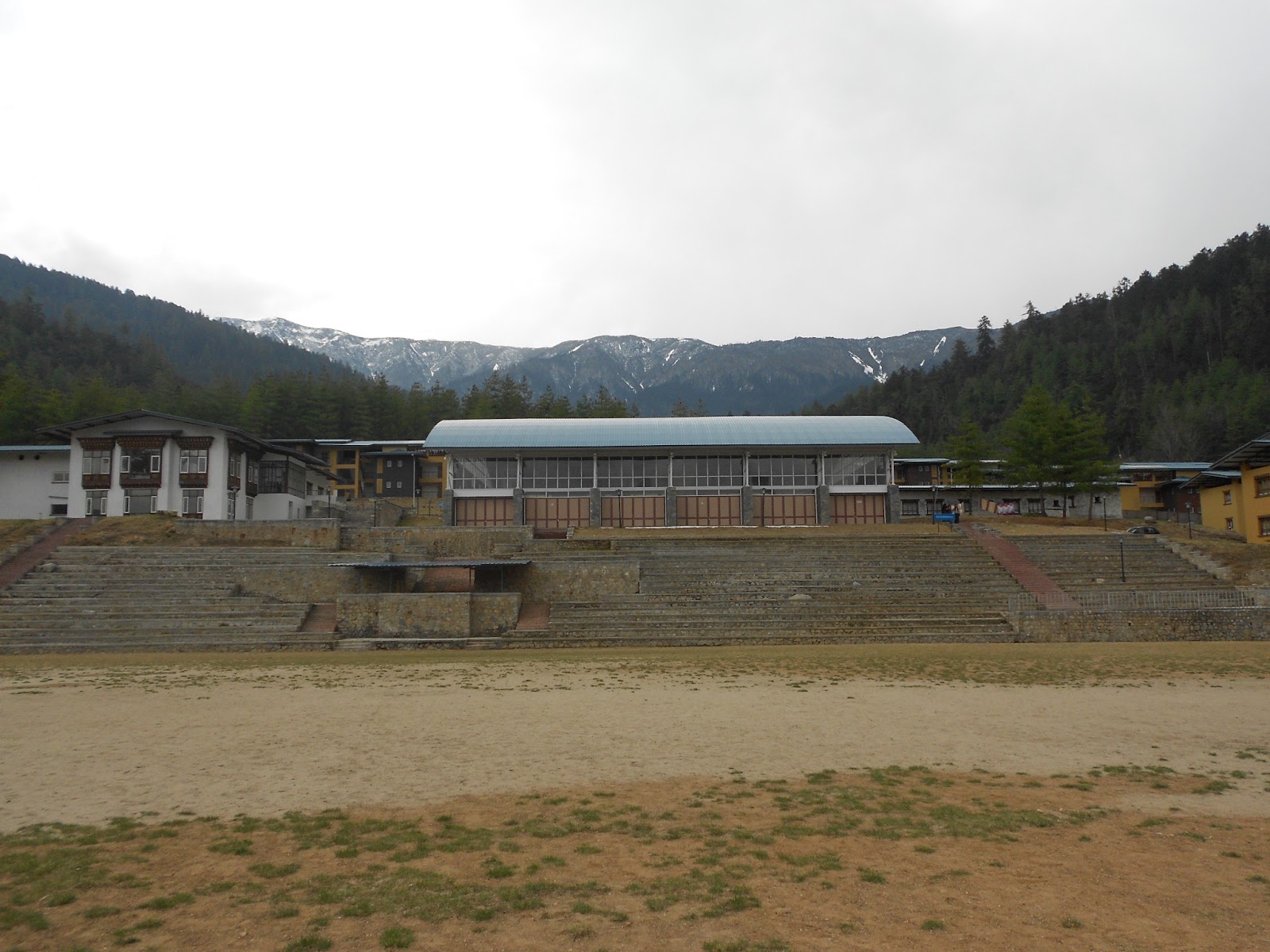 |
| Looking up campus toward the Gym and the Mess and mountains behind. |
 |
| wild Primula blooming in the forest near campus |
The set-up of the Wheaton in Bhutan program is that I am enrolled in three courses at the Royal Thimphu College (RTC) and participate in an internship/practicum in addition. Two of the courses are taught by our Professor Owens, the director of the program this semester who is our teacher and group leader; these are the classes I take with the ten other Wheaton students in this program. These courses are called Contemporary Bhutanese Society (CBS), and Bhutanese Language and Culture (BLC). The third course is one which I take with my Bhutanese peers under Professor Sharma. This one is called Environmental Impact Assessment (EIA). For my internship, I have successfully been accepted to work at the National Biodiversity Centre in Serbithang, which is about a half-hour walk from campus. I started working there today, in fact, so I will have more details to share on that soon.
 |
| A vegetable stand in the marketplace |
My EIA class meets every day Monday through Friday for an hour at varying times of day. It's usually lecture style with PowerPoint slides and a pretty typical classroom set up. There are about 20 students in my class. They are all in their sixth and final semester of RTC in either the Environmental Studies/English track or the Environmental Studies/Economics track. The way that "majors'' are set up at RTC is that students select a certain program to follow such as the two I just listed or others such as English/Dzongkha, Business, Political Science and so on, and then they take a pre-determined course load each semester for the three years that they are pursuing their degrees here. For RTC students, classes typically run from 9-5, with an hour off for lunch. Sometimes it isn't a full 9-5 schedule, but it certainly isn't the type of American-style college schedule in which students select their very personalized course loads and classes meet two or three times a week at various times of day.
While the CBS and BLC classes are the familiar student-teacher dynamic of seminar-style courses back home, the classroom setting is very different in EIA. The main topic of the class is the evaluation process that development projects go through in order to protect the environment before, during, and after construction. We are covering a fair amount of material, but frankly, even though the lectures are interesting, they are fairly repetitious, and don't really engage the students. RTC is challenging the traditional learning-by-rote style of education in Bhutan, in which students are just supposed to absorb and memorize what their teacher tells them, but the students almost never ask questions, and at least so far, aren't really required to process the information--just to take it in. One class, when we were instructed to get in small groups and discuss part of the chapter in the textbook, I asked my groupmates what they thought of a certain passage. I said something like: why do you think the author is saying it's so important to have public participation in the review process of these projects? My groupmate answered me by pointing to a line in the textbook and said "well...because they say this" and then read me back the passage.
 |
| Classrooms and various campus buildings |
 |
| A happy discovery while exploring the forest road |
I know I shouldn't feel such a strong impulse to go be an introvert on a rock under a log, and I'm working on it, and I’m trying to make real friends beyond the Wheatie group. It's tough, and I haven't thought so much about what other people think of me since braces and really frizzy hair were the most prominent things on my mind. BUT! Let me talk about things outside class, because they are much more interesting.
OH Man do Bhutanese kids like to party. Whaaat? Well, actually, this shouldn't have been such a surprise, but given the pretty strong rules on campus, I was pretty shocked, though glad for all the wicked fun times we have had so far. There are very strict laws about tobacco in Bhutan (more so than cannabis--though I'm not sure what the laws are about that--it grows on the roadside) but cigarettes are really popular. Hash is more popular than grass as far as weed goes. Drinking age is 18, though I was told that as long as you don't look like a little kid, you can pretty easily buy alcohol. The two local beers are Red Panda and Druk 11000, and the Druk is much better, and less expensive. The beer comes in liter bottles (similar to a forty back home) and a Druk is usually 55 ngu at the Eight-Eleven supermarket, though about 150 ngu at bars. There are all your regular kinds of liquor for sale too, but the special drink of Bhutan, which is often mandatory at some rituals, like funerals, is ara. It can be brewed from all kinds of grains: rice, buckwheat, you name it, but it is a clear, very strong alcohol served either cold or hot, apparently sometimes with bits of egg in it. It tastes similar to vodka, though maybe a touch sweeter.
 |
| Tonight's dinner: maggie noodles, dahl, kewadatse (like emadatse but with taters) and fried rice |
In addition to the three square meals in the mess there is also tea-time in the afternoon where either butter tea or a really sweet milky black tea is served with crackers (biscuits). There's also the canteen, which has other options during the day like momos which are cheesy, cabbage-y dumplings (sooo yummy) or chow mein, or sandwiches. There are a bunch of feral dogs that live on campus, most of whom are very friendly and have assorted names. They hang out near the mess most of the time and beg for food, and though we aren't really supposed to, I oblige when the meat has too many bones for me to eat most of it.
 |
| My Hostel, Chhukhar Res Hall, at RTC |
 |
| My room, and me! Kunzang let me borrow her kira on this day. |
I am worried that so much of this sounds like complaints. I hope it doesn't seem that way, and please know that most of these things make me laugh, and that I am surrounded by so much beauty and new and exciting things that any unpleasantries are really not a big deal. Nonetheless, I miss you and always love hearing from you. I am thrilled to answer your emails, so please write with your own stories or with any questions you would like me to try and answer. Much love to you from me!
 |
| Here's the wind horse I mentioned in a previous post. May he or she carry many good thoughts your way! |
P.S. I neglected to mention it on the day, but March 20th was Happiness Day in Bhutan, and the streets in Thimphu were full of people milling about, checking out the street food stands, and celebrating the day off. I hope it was a happy day for you too!

 |
| Crowds gathering for Happiness Day in Thimphu on March 20, 2013 |
Thursday, March 7, 2013
Tiger's Nest
 |
| Approaching Paro Taktsang, photo by Catherine Perkins |
On Tuesday the 26th, we visited the Paro Dzong and hiked to the Tiger's Nest (Paro Taktsang.) This was a very exciting day, so I'd like to dedicate a whole post to it.
 |
| Paro Dzong |
 |
| The Four Friends, painted inside the dzong. Tsewang is wearing the gho with the kabne sash. |
Unfortunately, I don’t have any non-blurry pictures of this artwork, but the wheel of life is particularly fascinating. From my limited knowledge, it depicts the six groups of sentient beings within the wheel of karma. The three groups at the top are humans, demi-gods, and gods. The three at the bottom are animals, hungry ghosts, and hell. All of these groups experience suffering, and depending on one’s karma, one moves between the groups throughout one’s reincarnations. Karma is poisoned by ignorance, hate/anger, desire, jealousy, and pride. According to Tsewang, it is best to be born as a human because this is the only group exposed to Buddhist teachings, through which one can attain enlightenment and exit the wheel. Living ignorantly could lead to being born as an animal next time, anger and hate often led to a life or lives in hell, and greed or desire could lead to being a hungry ghost, whose bellies are giant but whose throats are only big enough to allow one drop of water at a time. Tsewang emphasized the importance of compassion and thinking before acting, because even killing a fly could mean you would come back as a fly 500 times, and be subjected to the same suffering of being swatted. There is some contradiction, at least in my mind, in these teachings, because many Bhutanese do eat meat, which can be considered killing. It is probably just a matter of my still being ignorant, but I did start to appreciate that my past lives must have attained a great amount of karma in order for me to have the incredible opportunity to be here and be exposed to all of this.
We also toured some of the shrines in the dzong, and admired the architecture, but we left soon enough in order to be sure we would have time to climb to the Tiger’s Nest. We drove about half an hour outside of the city of Paro to the trailhead toward the temple on the cliff-side. At the beginning of the hike, women had trinkets and flags and other wares for sale spread out on blankets at the side of the trail. A popular item was the “diamond thunderbolt” or Vajra often held by the wish-granting Lord of Compassion, symbolizing the ability of wisdom to cut through ignorance. The form of Buddhism practiced most in Bhutan: Vajrayana Buddhism is related to this word.
 |
| Tiger's Nest, about halfway through the hike. |
 |
| Horses along the trail |
 |
| Lunch! |
We soon continued on our way, and passed a cave where one of the Je Khempos, similar to an abbott (a leader of the monastic body) had been born. I could not imagine hiking these mountains pregnant, and I gained another piece of appreciation for the durability and amazing power of the human body and spirit. A few more switchbacks of trail and a few more turns, and we had made it around the gorge that separates the cliff from the mountain we had been climbing. We turned a corner where the stairs began to lead down and then back up, and were able to fully behold the Tiger’s Nest for the first time.
 |
| Paro Taktsang or Tiger's Nest |
Dozens of strings of prayer flags hung across the gap between one part of the cliff and the other, combining the gray and black stone of the cliff wall with the rainbow assortment of flags, and the white, brown and gold of the temple reflecting in the sunlight. A waterfall poured down to the side of the temple, and many small buildings and shrines stood tucked away into the nooks and faces of the sheer cliff, with only the cut steps and stairs of stone leading up to them.
 |
| Looking back down the trail from the temple entrance |
We entered through a doorway and I put my long skirt and sweater over my hiking clothes, as I did for the dzong earlier. We had to leave our bags behind in a cupboard, and Tsewang led us into the temple. We climbed a few more sets of stairs and then paused at a large stone. A thumb sized depression was formed into it at about hip-height, and Tsewang instructed us to stand about ten feet away, close our eyes, think about what we are grateful for, and then walk toward the stone with an arm outstretched. The goal was to place your thumb inside this depression, within three tries. If you could, it meant that you were more likely to repay your parent’s generosity in this lifetime. Unfortunately I was unsuccessful, so I’m afraid I’ll have to keep working on it next life, Mom and Dad.
We visited five shrines within the temple, since five is a more auspicious number than four, including one with a large statue of Buddha with a very incredible story. It is said that some monks were carrying the statue up to the temple, but at this time, there were no stairs yet, and the statue was very heavy and unwieldy, and difficult to carry around the narrow paths of the cliff. The sun was going down, and the monks were afraid, so the statue suddenly spoke to them and said that they were allowed to leave him there on the side of the cliff for the night. The next morning when they awoke and went to bring the statue the rest of the way, they found that it was already in place inside the temple.
 |
| the gorge below the waterfall, the temple is at the top of this image |
The sun was beginning to go down on our visit as well, so we re-gathered our belongings and set back down the trail toward the base of the mountain. I had overheard some people speaking German at the temple, and while pausing to catch my breath at the top of a set of stairs, I struck up a conversion with one of the women in that group. It turned out that they were a group of German Buddhists from Frankfurt who came to Bhutan on a two-week pilgrimage. I had a great conversation with this woman, Christina (in Deutsch! Yay!) and when we met up again at the very end of the trail, she wrote down her email and address and told me to contact her if I was near Frankfurt this summer, and that she would show me around her town! I was floored, and totally psyched, and amazed at the connections I have and can make around the world. Who would’ve thought. My mind is blown. Every day.
Next time I’ll write about life here at R.T.C. and my experiences so far in Thimphu. I am sending much love your way! On a final note for now, here are some wicked funky gold-tipped chrysalises that were on a fence by the temple. How weird are living things.
 |
| unknown caterpillar chrysalises |
Friday, March 1, 2013
Kuzu zangpo la!

I am in Bhutan! We arrived on the 25th in Paro after a somewhat tricky snag in the travel plans when we landed in Bangkok, Thailand on the 23rd. All that meant was that one of our group didn't have the documentation she needed to enter Thailand since she is not a US citizen, and so she and I stayed in the airport hotel until our flight with Druk Air into Bhutan. It all got cleared away, and the rest of the travels have been smooth sailing. I am moved into my room at the Royal Thimphu College, and we started classes today. It is a lot to get used to, and is at times a little overwhelming, but it has been an incredible ride so far, and it has only been one week!
But, before I get ahead of myself, I should back up to the beginning. Mom dropped me off in Boston last Friday morning (thanks Mom!) and all the flights went smoothly, though I was surprised that the longest leg--the 14 hour flight between Washington D.C. and Tokyo was the most comfortable. I did have a great conversation with a guy named Matt on his way to Portland on the flight from Boston to D.C., who was one of the few people I had met at the point who knew quite a bit about Bhutan! He had done a year teaching English in South Korea, and said he loved living in Asia.
 |
| Mountains in Easternmost Russia |
Flying above Japan was also very beautiful, with volcanic craters and mountains interspersed with the straight lines of cities and roads. The turn-around to the flight to Bangkok was quick and I slept most of the way there. However, when we got to Bangkok, we had that snag, but in time we sorted it out, and Ana and I eventually got to the hotel airport (Louis' Tavern Dayrooms, rentable by the hour) and called it a night. We ended up having a great time in the airport the next day, wandering through all the shops, and making fools of ourselves taking pictures with all the random airport statues and whatnot. We got some pitchers of Thai Chang and Tiger beer, but couldn't buy anything else in the shops since the airport officers had confiscated our passports (I guess to make sure we wouldn't try to get through immigration again, and so that they could set up things with Druk Air for our flight) and they require seeing your passport when making any purchases at the shops. Oh well. We'll see Bangkok on the return in July. That seems so far away right now!
 |
| Druk Air Airbus A319 at Paro International Airport |
Coming into Paro was smooth, but because of my seat and the clouds, I couldn't see much of the landscape as we were coming into the airport. They do the whole landing by sight though, without much other navigational equipment due to the complicated terrain around the airport, so it was a very impressive landing.
At the airport we went though customs, paid the $40 entrance fee, collected our bags, and exchanged our dollars into ngultrum. About 55 ngultrum equal 1 US dollar. From there we met our guide, Tsewang, who took us to all of our stops in Paro and Thimphu so far, and will guide us on any other excursions we do outside Thimphu through the semester. He is a very smiley, energetic, trove of knowledge and kindness.
 |
| The Conch-shaped Museum Building |
"Auspicious" is the word of Bhutan. Tashi delek is a phrase meaning something along the lines of "auspiciousness and blessings;" odd numbers are more auspicious than even numbers, the eighth, tenth, fifteenth, and thirtieth days of the Bhutanese lunar calendar are auspicious days in which it is especially common for people to visit temples, and so forth with many other examples.
 |
| Kyichu Lhakhang Temple |
That first day we also visited a temple called Kyichu Lhakhang after checking into our hotel: the Jigmeling Hotel. The Kyichu Lhakhang is one of the oldest temples in Bhutan. It was built in the 7th century as one of 108 temples built to subjugate a demoness/ogress. The temple there in Paro was built on her foot; there is another to the north I believe built on her knee. The two buildings (one from the seventh century, and the other from the 20th as a commission from the third queen if I remember correctly) have prayer wheels built into shelves in the walls. These must always be spun clockwise, and when spun, release the prayers and mantras written thousands of times on the scrolls rolled inside the prayer wheels. Inside, monks were chanting and playing instruments, and a few of them chuckled as us in our western clothing and clear bewilderment at what was going on.
 |
| Prayer Wheels in the wall of the Temple |
No pictures are allowed inside any temple, shrine, or dzong, but these areas are always covered in paintings and weavings and statues to the many deities and their multiple incarnations. Conservation of these works of art is becoming a big movement, and so now, some of the walls are covered with cloth or plastic sheets in order to protect them from the harm of incense or butter lamp smoke. We were lucky to find the door off the innermost shrine of the Buddha inside the temple. We were also told to offer our wishes to the Lord of Compassion who has eleven heads and a thousand arms in order to help him uplift as many at once as he can. But, Tsewang said, the best wishes are those that are big, and extend beyond oneself to your family and all of your past lives and past parents too.

We returned to the hotel for our first Bhutanese dinner. The meals at restaurants and the hotel have more variety than the meals here at the college, but I am getting used to the food more or less. There is always rice (food and rice are the same word in Dzongka) and there are usually chiles in a spicy cheese sauce. Sometimes there have been fried vegetables or momo, a type of dumpling. Tea and/or broth is usually also served, and sometimes there is a cabbage dish as well. Most things are very spicy or very salty, or both.
The name of our hotel means somethings like "expansive place" and it was a very comfortable stay. The blankets here are very thick, and once we figured out how to use the giesers (the water heater) we could take warm showers. Across from our hotel was a textile shop where women wove very intricate kira. Kira are the national dress for women, and it consists of a waist-to-ankle wrap skirt, a blouse called a wanju and a jacket called a tego. This shop across the street was apparently where the kira worn by the new queen in the royal wedding was made. I didn't get a chance to look around in that shop, but we did wander through a few shops selling thankas or jewelry or trinkets or electronics. I haven't bought any souvenirs yet, but shopping here is certainly an experience. It's somewhat unpredictable what will be sold in each store.
 |
| A man shooting archery in Paro |
We also walked past an archery match where two groups of men in their gho (the tunic-like national dress of men) where playing a game for fun or practice. They used compound bows, and shot at a target that was about 125 yards away. And they hit it! It was unbelievable. The two teams would make fun of eachother in order to distract the shooter, but their aim is true nonetheless. I might try to be involved in the archery club here at RTC; I was told I should be able to, even though I am a girl, and archery is usually only for men.
I will write more very soon to catch you up on the last few days leading up to the present. We have done a few hikes, and even after spending a week here, and doing a fair amount of exploring, it all feels entirely unreal. Bhutan is spectacular to witness in all of the senses--visually, tactility, spiritually. I have much more to share with you! And please, always feel free to email me with thoughts, questions, or whatever else you would like. I'd love to hear from you!
P.S. I have learned how to say two dzongka words for sure. They are Kuzu zangpo la, which is a polite greeting, and (not sure of the spelling on this one) Ka dinche la which means thank you. Hopefully I'll learn more with time.
 |
| Looking north from the Paro Dzong |
Subscribe to:
Posts (Atom)