Tuesday, January 20, 2015

Great Ocean Road


views along the Great Ocean Road, Victoria, Australia

When I got to Australia, I met up with my dear friend David. Our times in Australia overlapped, so we decided to rent a car and spend a few weeks on the road touring Victoria. We began in Melbourne, picked up our car (with roof tent) from Wicked Rentals and set forth toward the coast. The first thing we learned was "stay sexy--stay left." We were not the quickest learners but we never hit anything! The second thing was to teach me how to drive standard transmission. Let's just say we were better at staying left than I was at mastering manual driving, but hey--I'll get better.

some of the Twelve Apostles along the Great Ocean Road
We detoured from the true start of the Great Ocean Road by first driving along the Bellarine Peninsula. From Torquay we picked up the classic route and traveled on past Anglesea. The coastline along the Southern Ocean features spectacular sheer limestone and basalt cliffs, the occasional sandy beach, and a smattering of coastal towns and villages. It makes for beautiful driving. It's summertime (albeit a chillier one than usual) here in Australia and the Great Ocean Road was the place to BE.

Nonetheless, it was never very crowded and we figured--ehh we'll just stop into some caravan park or campground, no planning ahead necessary. This was wrong. It was New Year's Eve. Everywhere was booked. We didn't worry though (every Aussie we'd met told us "no worries"), and we always found a safe place to sleep.

Some of these places were National Parks. Some places were State Parks. Some places were Recreation Parks. Some places were Cemeteries. Ok--many of the places were cemeteries. This turned out to be a pretty good idea of ours. Lots of privacy. Nice (or spooky) epitaphs to read. Good story-making with various discoveries of very large spiders, sheep employed as groundskeepers/lawnmowers, beautiful (and not too macabre) sunsets.

rock art of Bunjil, a creator spirit, in Gariwerd
No matter where we stayed during our nights, our days were delightful. Being on a careful budget, we were very pleased with the range of things to do free or cheaply. Much time was had exploring the beaches and tide pools, visiting museums, perusing bookstores and op-shops, driving/walking in the bush. In Bendigo (once the world's greatest gold town) I had my introduction to Bush Poetry, the tradition of balladeers singing or reciting rhymes about life on the frontier, wrangling horses, hunting outlaws... I've also started reading everything I can about Aboriginal folklore, thanks to my start learning about this and visiting the rock art in Grampians Nat'l Park (Gariwerd).

the Enchanted Forest
Our favorite stop along the road was the town of Portland, even though the guidebook describes it as "falling short of its potential." We visited a Petrified Forest (actually sandstone, not petrified wood), an Enchanted Forest (actually magic, not easy to find), and got to watch an impromptu dance/photography session of some members of the Fighting Gunditjmara at our campsite on Mt Richmond. The men were kind enough to let us watch, and I traded a poetry recitation in exchange.

me, David, and two members of the Fighting Gunditjmara
When we reached the end of the Great Ocean Road in Nelson, we traveled inland to see the Princess Margaret Caves, the Grampians National Park, the Murray River, the Yarra Ranges, and the Hanging Rock. While each had their gems, our visit to the Hanging Rock surpassed the others in my emotional reaction.

The Hanging Rock was made internationally famous by Joan Lindsay's 1967 novel, detailing the fictitious (or not??) mystery of three 19th century schoolgirls who go missing during one picnic lunch at the Rock. "Rock" is always capitalized. I'd picked up this novel at the beginning of our road trip, and David and I had been taking turns reading it aloud to each other. It's a beautiful mystery. The best scenes are those when Lindsay zooms out and shows the reader parts of the scene that the characters fail to notice:

“Insulated from natural contacts with earth, air and sunlight, by corsets pressing on the solar plexus, by voluminous petticoats, cotton stockings and kid boots, the drowsy, well-fed girls lounging in the shade were no more a part of their environment than figures in a photograph album, arbitrarily posed against a backcloth of cork rocks and cardboard trees.” 

exploring Hanging Rock
The Rock is a sacred site to the local Wurrenjerrie, and information at the entrance wrote that many people, especially the Wurrenjerrie feel a deep sense of foreboding at the site. I was anxious to check it out for myself. David and I explored the peculiar, soaring, teetering faces of the Rock, and I found myself getting nervous, even though there was no apparent danger (unless one slipped down in one of the narrow, steep crevices). I felt watched. Paranoid even. I asked David how he felt and he said 'good, like he felt he could become part of the Rock.' I was shocked, and irritated by all the other tourists who were having such a gleeful time. What was going on with me? I sat down, trying to puzzle out my reaction, when I at last articulated that I knew the Rock didn't trust me.

I know that sounds kinda crazy.

You should probably be beginning to expect this particular brand of crazy from me. I'm trying hard these days to relate to the landscape personally. I want to do the opposite of personification. I can't find a satisfying term for this. Suggestions?

I decided at the time that some meditation was in order. I took off my shoes and socks and sat near one of the extrusion boulder formations. David joined me. We sat there for several minutes and soon the other tourists quieted or disappeared. When I opened my eyes, we were alone and the color of the rocks was a bit brighter. I felt calmer. I closed my eyes again and fell asleep, realizing later the odd symmetry of this scene with the one in the novel, immediately before the girls go missing. Still, I felt comforted.

When we awoke, we gathered our things and proceeded up the trail to the summit. The entire place seemed friendlier, less watchful. Perhaps it's all imaginary, but perhaps these connotations are real. I cannot see that it makes much difference either way.

--------

The next day, David and I returned to Melbourne and returned the car no worse for wear beside the 3000 extra km we achieved. I checked into my hostel and we walked to the train station. When he boarded, I walked away, and tried to feel brave. I think I succeeded, but I also felt pretty dang sad.

It's hard to say goodbye to someone you love very much and be unsure when you'll see them again. But, that is what we had to do, and now I'm back on my own. I'm in Melbourne another couple weeks, living in a city for the first real time. It's neat. I'm digging the anonymity. There are restaurants with food I've never tried before. I'm finding interesting stuff to do and the State Library is gorrggeous. Soon, I head north through the interior to Darwin.

I anticipate I'll feel a more acute loneliness in the coming days, having had the joyful gift of such good companionship the last couple weeks. I will not see another familiar face in person until I get home, just over six months from now. But that is the nature of the year. It's something I intend to relish.


All that aside, if anyone has tips on how to get a Chinese visa, please HELP meee. I'm so confused.


Wishing you many exciting journeys, and hoping to hear from you soon,
Carrie
me and David on the Great Ocean Road


P.S. Aaugh. Too many stories for one measly post. Ask me sometime about all the wildlife we saw! Stories include kangaroos, wallabies, owls, eagles, koalas, echidnas, platypus, parrots, cockatoos, tawny frogmouth, wombats, and something that made mysterious wild pig sounds for three nights in a row! 


Tuesday, December 23, 2014

Victoria Falls / Mosi oa Tunya

Devil's Cataract with a raaaainbow!

the first viewpoint
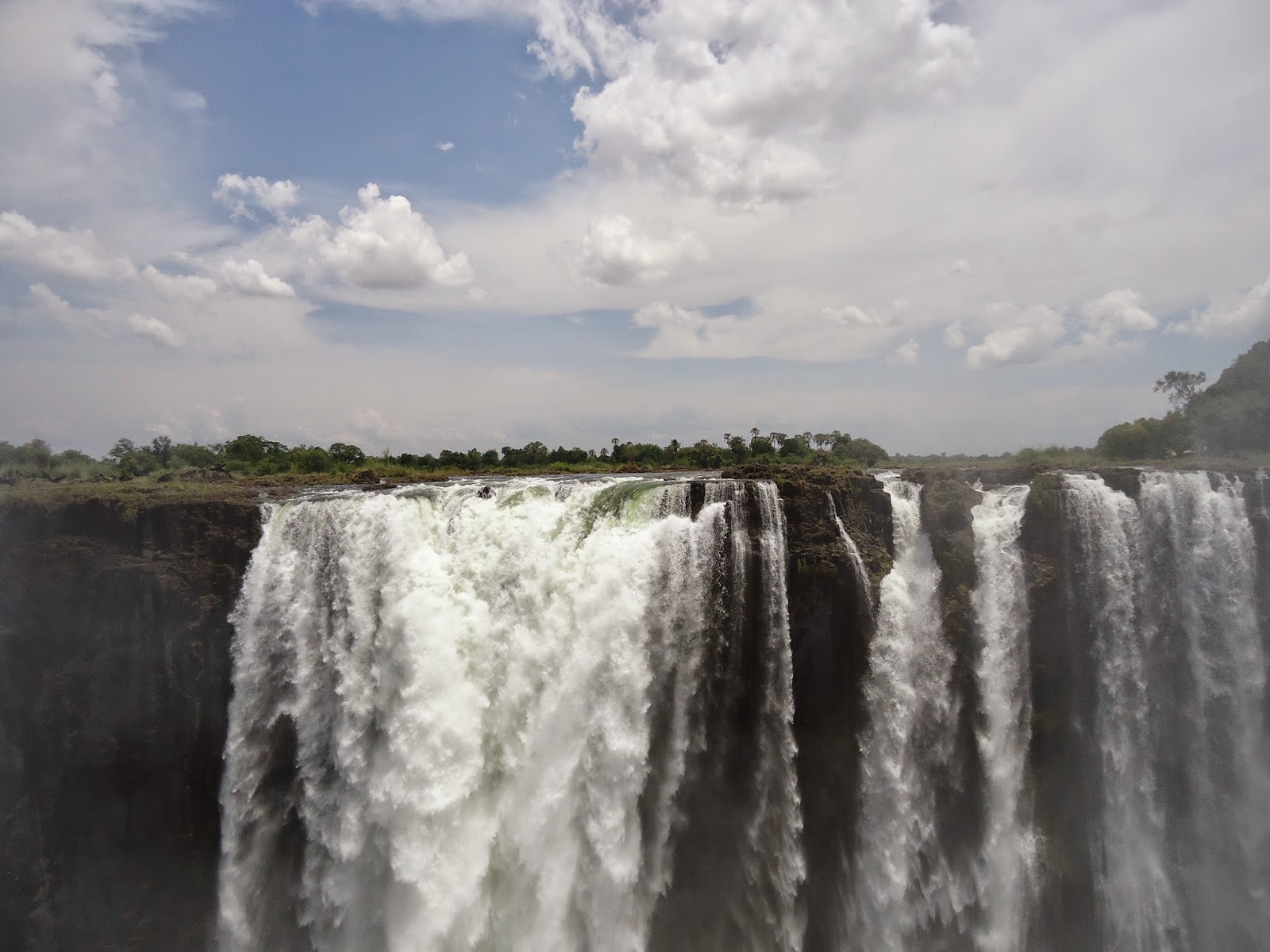
Victoria Falls brought me to tears. It is so crazy beautiful that I could not help lingering at the many viewpoints, and (when there weren’t too many other tourists around) literally yelling about how amazing it is. I had to hold my head on because it was about to float away from me and drop down the cliff with those waters. I settled to imagine I was any one of the dragonflies or sparrows darting over the edge and into the gorge.


I visited the Zimbabwe side. This has the best views of the falls. If you visit the Zambia side, you can actually go in the water right at the edge where a natural “armchair” formation called Devil’s Pool allows you to sit right at the crest of the waterfall. I watched some crazy people do this. Someday when I come back, I’ll try it myself.


the Main Falls at low water

Devil's Pool at the edge of the Main Falls

There are 16 viewpoints along the walk, stretching from the statue of Livingstone overlooking the Zambezi near Devil’s Cataract to the Main Falls, then further along the gorge to Horseshoe Falls, Rainbow Falls and the Eastern Cataract. It’s a few kilometer walk with areas near the main spray that are thick like rainforest down to bare basalt rock in the driest portions near Rainbow Falls.


The Main Falls
Victoria Falls is also called Mosi-oa-Tunya, “the smoke that thunders.” It overwhelms the senses. I’m told that during high water in April and May, you can’t even see the water for all the clouds of vapor rushing off the rocks as the falls plummet and crash. But, now in December, it’s low water. The falls are not continuous, but separated into distinct portions around the island rivers. In some portions you can see the basalt cliffs behind the water. I was amazed to see lichen growing on them. What an incredible survivor.


It is no surprise that this place is one of the Seven Wonders of the World. It’s exquisite and ferocious. It steals my words and flings them hundreds of feet down into white and green froth, soaking them for a moment in perpetual rainbows.


What drives me the most absolute out of my mind with thrill for waterfalls is that they are never the same. (Ok--sure, that’s true of everything if you want to get esoteric. But bear with me.) Each surge of water, if you can separate the continual outpour, is a different compilation of droplets, molecules, etc. Even though it looks like a solid sheet of water, you can watch each distinct portion as it moves from the edge down back to become river again. For a moment, it is purely suspended in freefall.
Horseshoe and Rainbow Falls


I wonder what it feels like as it falls. I do not aim to find out in this lifetime. Of course, a rare hippo, crocodile or clumsy tourist does go over the edge and is smashed to bits at the bottom, sometime recovered in the Boiling Pot downstream.


Perhaps the pictures do a better job of describing the experience than I have in writing. The water itself tells the best story though, and I urge you to come listen to it for yourself. We could even come back together.


With love,

Carrie

me at the Main Falls

Kasane


elephants in Chobe National Park
I went to Kasane without any real plans. Said I’d figure it out when I got here. But it's all worked out wicked well. I got lucky that, out of all the phone numbers I called, the most affordable one was the only one with a room available. My home this week is run by some of the most helpful people I’ve yet met.


My accommodations here in Kasane have been Bophirimo Guesthouse run by Kebonye and Simon. They have helped to connect me with the folks who run the Chobe Snake Park, a local geologist and literature aficionado, and best of all, two local writers: Peter Comely, a safari guide and novelist, and very accomplished poet Onalethuso Petruss Ntema. Meeting these two has been very inspiring. And they both signed copies of their books for me. (Score!)These are the connections I look for. Serendipity is a real blessing.


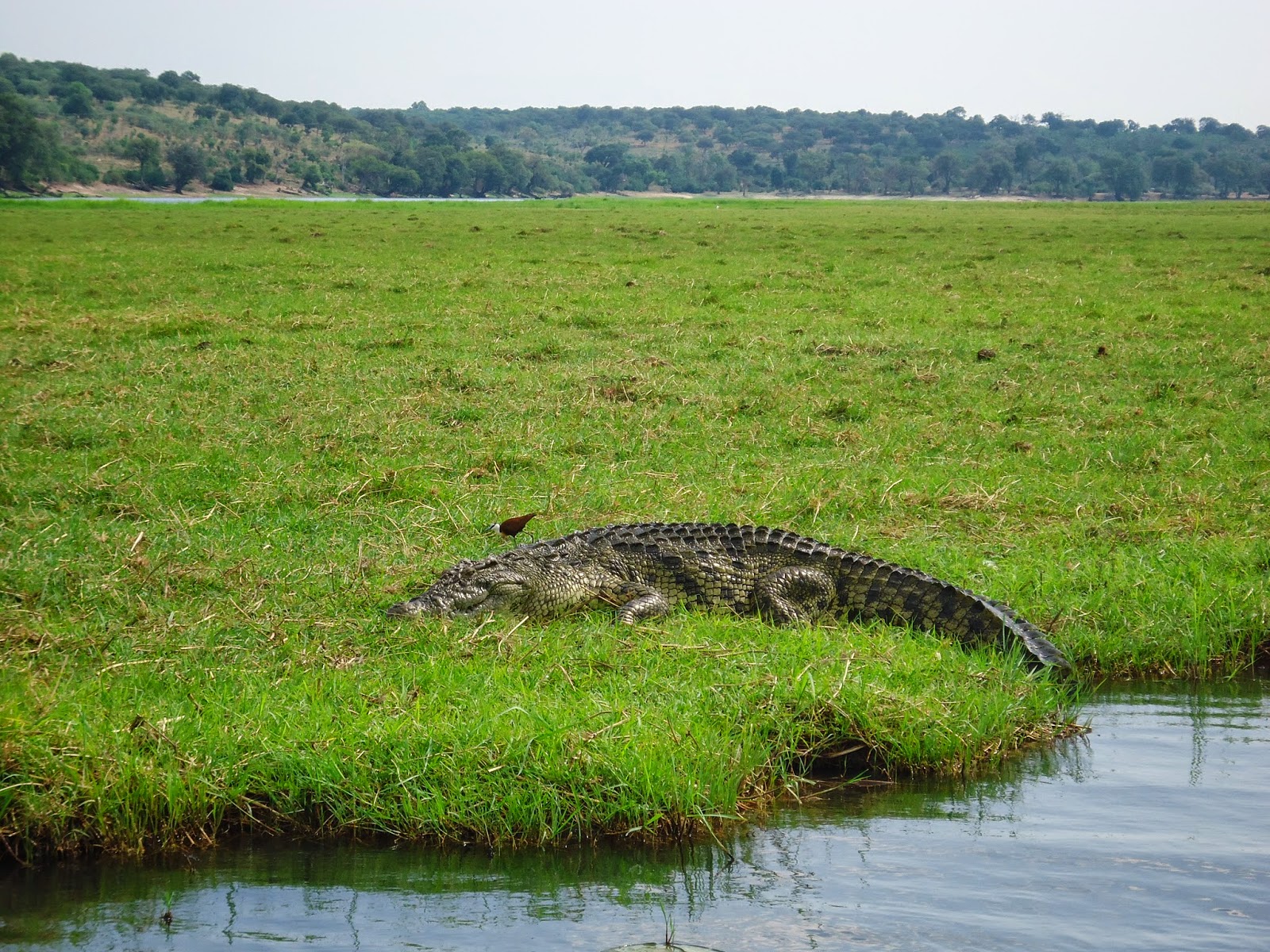
crocodile on Sedudu Island between Botswana and Namibia
I’ve visited the Caprivi Strip in Namibia, crossing the convergence of the Chobe and Zambezi Rivers to play a homemade marimba and watch pied kingfishers, crocodiles, and hippos along the riverbank. The reeds on the island in the middle of the river had been mown flat by the local herds of elephants.


I visited the Chobe Snake Park and Biodiversity Centre where they keep a variety of snakes and other rehabbed wildlife. Some were local captures, others were recovered from smugglers, or found injured by poison or car-strikes. I got to hold pythons, brown house snakes, and beaked snakes. I kept my distance behind the glass from the puff adders and black mamba, admiring these deadly creatures.


Chobe is elephant territory
Best of all, the staff at the Snake Park let me tag along to help with some of their research projects. That turned out to be an extraordinary day. Someone had called in a report of an injured white-backed vulture. This individual seemed to be poisoned, potentially by Rat-X. With the proper permit clearance from the wildlife department, the vulture, dubbed Jiles, was brought back to the centre for food and water and some charcoal tablets to help absorb the poison. Latest I've heard is that he's doing well and soon to be released.


I helped with a community study of diseases carried by flies and got to talk the similarities between scientific and literary journals, the effects of poaching and anti-poaching efforts, local culture, and as they say here: all the what-what. Shop shop [Ok]. It was a great opportunity, plus he blogs about his experiences working in conservation, which is very affirming to me in my search for the connections between conservation and writing.


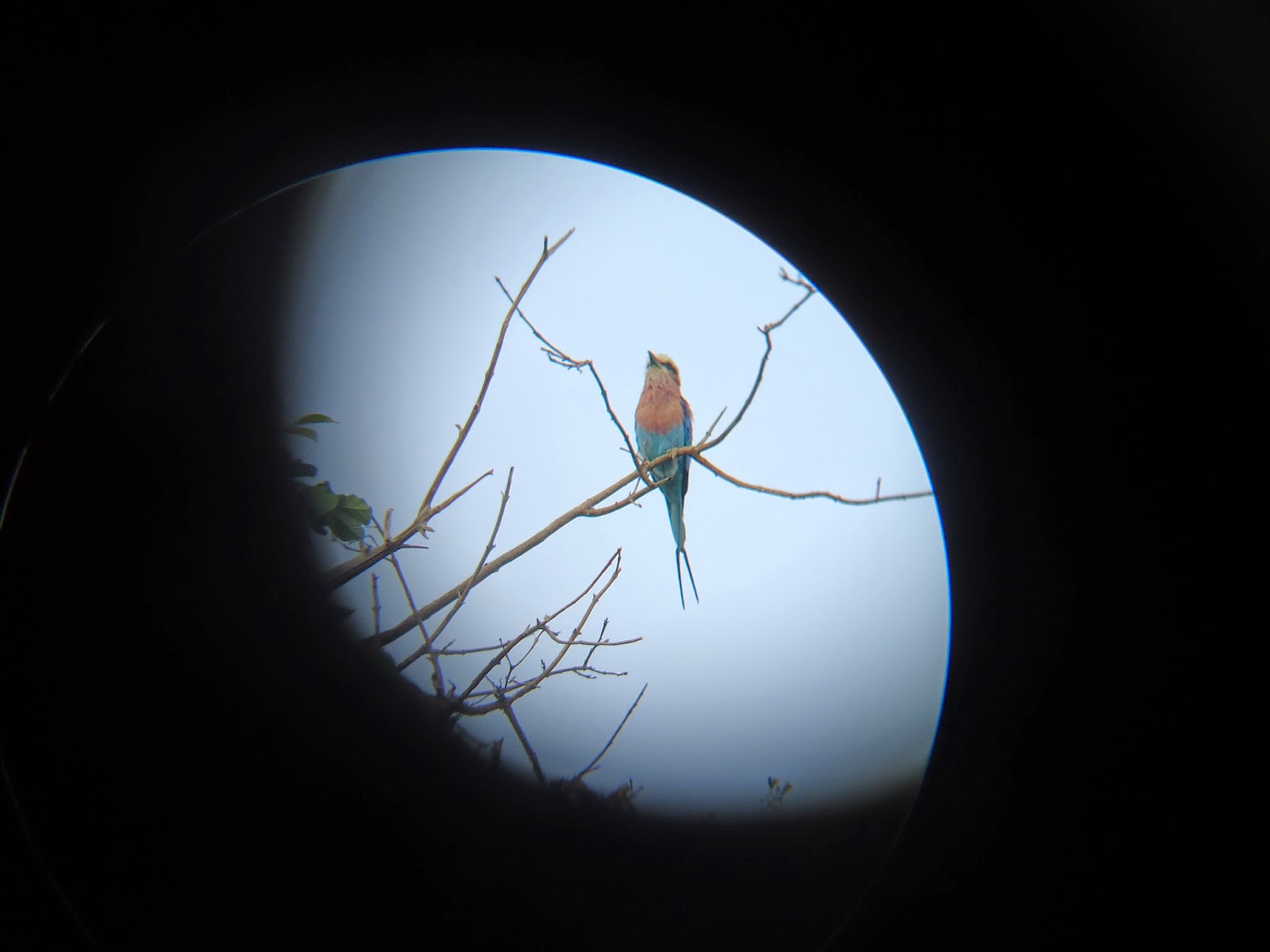
Lilac Breasted Roller
I also got to visit Victoria Falls, but that’s going to be a blog entry of its own. I hope to return to Kasane someday. I’ve loved it here, and highly recommend Bophirimo Guesthouse to you when you come.


Next time I see you, ask me about the night on the wildlife corridor when I stood in a herd of elephant. Ahemdullah.


Love,
Carrie  
big ol bull elephant (guess how you can tell)


Khama Rhino Sanctuary

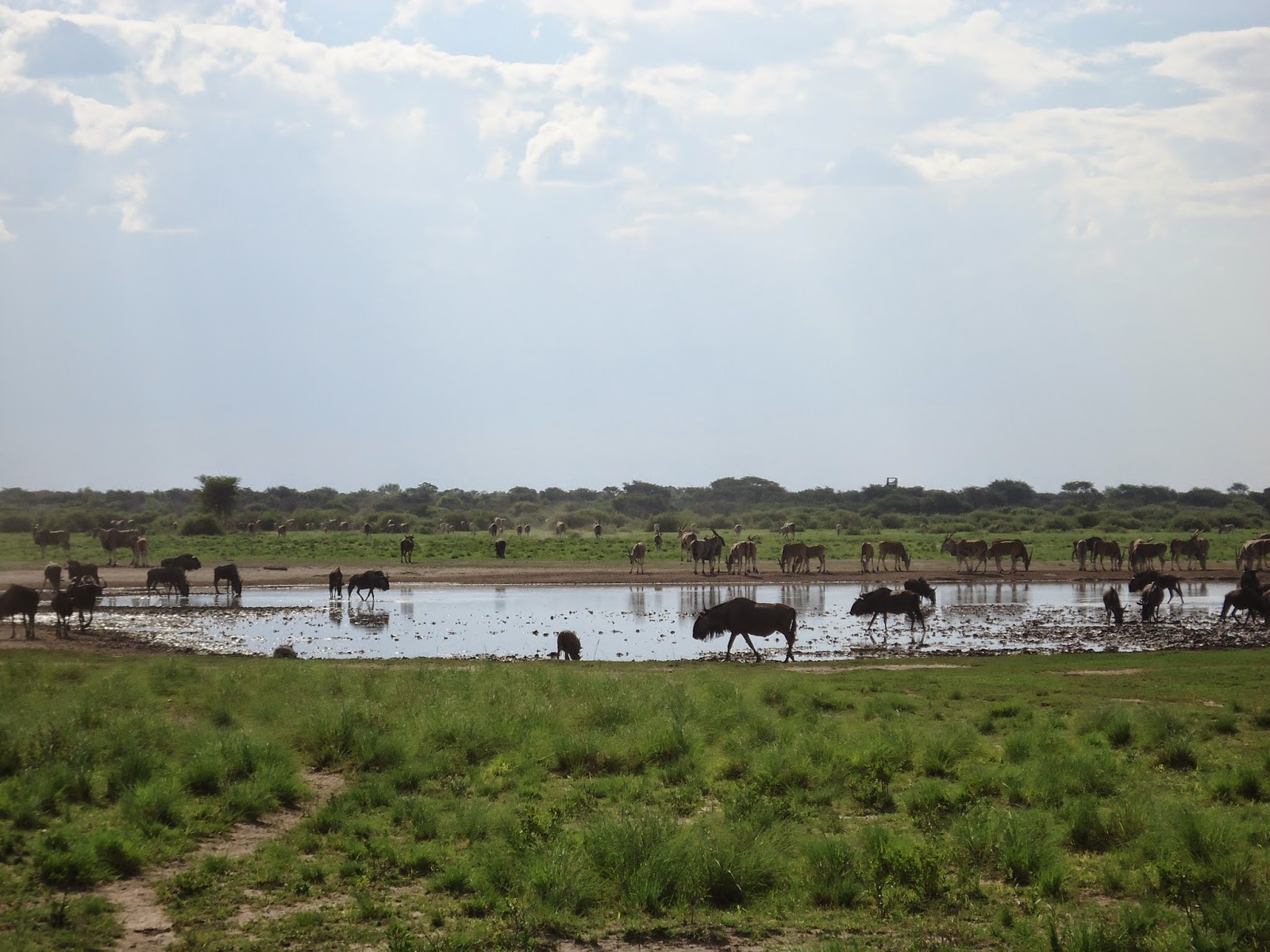
zebra and wildebeest at the pans


My major nature conservation work here in Botswana has been at Khama Rhino Sanctuary. I came in through the Botswana Workcamp Association, which was the most feasible way for me to volunteer in the sanctuary. I was there for two weeks at the end of November and returned in December for another two week stint.


Khama Rhino Sanctuary entrance
Khama Rhino Sanctuary is a non-profit community based conservation organization operated by the three neighboring villages of Serowe, Paje, and Mabeleapudi. It’s about 8500 hectares of protected land intended primarily to conserve the white rhino and black rhino populations, though there’s tons of other wildlife as well. There’s a perimeter fence which keeps animals in (most of the time) and poachers out (ideally). Both are capable of breaking through, like the pair of sparring kudu who crashed through several fenceposts one day during my time there. But the fence certainly makes one question the real definition of “wild.” Which is just what I’m supposed to be doing. It’s one of the major questions of my fellowship year.


But, this is supposed to be a travel blog, and I’m reluctant to post my yet-unarticulate philosophic mumbo-jumbo here. I want to tell you more about the rad things I’ve been doing.


I’ve been seeing so many animals that I never expected to see in real life, as well as (to be perfectly honest) some that I’d never even heard of before. In a lot of ways, this year is revealing so much of my ignorance and exposing me to listen to new stories, new ideas, new lifestyles, and new life histories. Nearly every day at Khama Rhino, on the drives between our campsite in the bush and our worksites at other places in the bush, I saw wildlife.


White Rhinos
Zebra, wildebeest, impala, warthog and white rhino were a nearly daily sight. I saw giraffe, kudu, eland, spring hares and springbok less commonly. The rarest sightings were a tortoise, chameleon, spotted hyena, jackal, and the crown jewel, a young leopard. Alas I didn’t always have my camera handy, but I felt incredibly blessed to witness these animals in the flesh in their real lives.


And I haven’t even mentioned the birds! Perhaps I’m listing too many things in this blog, but my life is flooded with all these amazing creatures. My heart is the ark and we’re set sail for far longer than forty days. Some of my favorite birds to see so far were the Maribu Storks (considered one of the Ugly Five that juxtapose Africa’s Big Five animals), Yellow-billed Kite, Go-away Bird (Grey Lorrie), and Crimson-breasted Shrike. Even the common Cape Turtledove that sings Bot-tswaaa-na Bot-tswaaa-na.


Giraffe
I’ve also seen so many neat bugs! Praying mantises have become my dear friends here. They are just too cool with all their different varieties. They all seem to love landing on me and climbing all over my arms and under my collar. It’s a bit tickly, but it feels like a blessing. The dung beetles zip across the pans at a zillion miles an hour and look like little hulks when they walk on land, deflty pushing balls of scat backwards in front of them.


The actual work at Khama Rhino often felt tangential to the wildlife, but I’m learning about how these tasks relate to the work of conservation overall. The people I met were an interesting mix of true nature lovers passionate about wildlife and others who liked wildlife but saw their involvement at the sanctuary as merely a job. Perhaps they’d rather be a nurse of a teacher or a taxi driver, but there’s work available here. Conservation is a business, and there are a lot of stakeholders.


After working, we cooked everything by open fire and I became good friends with the other volunteers as we chatted late into the night by the fireside. Fires and rivers and animals. I could watch them all forever.


More soon.


Love,
Carrie


firewood collection in the pick up truck selfie


Monday, November 17, 2014

Maru-a-Pula

Maru-a-Pula Campus

Today I leave the Maru-a-Pula school, where I have stayed my first few weeks in Botswana. Maru-a-Pula is a "co-ed, independent day & boarding secondary school with a reputation as one of Africa’s premier academic institutions" founded in 1972 as one of the first non-racial schools in the region. It's here in the capital city of Gaborone. I've been living on campus with some of the other teachers.

I was based in the school library, but I've been involved doing a few creative writing activities with some of the English classes and joined in the activities of the Permaculture and Wildlife student clubs. Working in the library has been really fun, and I secretly love reshelving the books. Of course I do. I get to handle so many troves of creativity and knowledge and make them more accessible to their readers. The library has a fair collection of books about Botswana or by Batswana writers, and I've been reading as many as I can. Some of my favorites have been Windsongs of the Kgalagadi by Barolong Seboni and Okavango Gods by Anthony Fleischer. 

Hoodia gorgonii, edible and medicinal succulent
Here at MaP, I helped to compile a guide to the campus flora. I spent a few days walking around campus with MaP's horticulturalist and wonderful plant enthusiast, Diphetogo. He taught me all about the many uses and lives of these plants. One tree, the Buffalo Thorn, for instance is purportedly lightning-resistant; another: Erythrina has knobby seed pods containing red lucky beans. If you carry them in your pocket, good luck may come to you. These are the things I love to learn about--it gives the plants so much character!

I think it was a good choice to start my stay in Bots here. I got to meet many poets at the several poetry events around Gaborone this month. There's a huge wealth of written and spoken word here, and I feel fortunate to have shown up in the right place at the right time. Last Friday, I got to go to the opening of a brand new poetry collection at the Gaborone Public Library. Poets TJ Dema, Gomolemo, and Moroka Moreri all spoke at the event, and it drew a big crowd to the library. 

Resurrection Plant comes back to life
after it dries and turns brown
I had met Moroka Moreri a few days prior for an interview. He is one of Botswana's traditional praise poets. He is capable of composing vocal poems, in couplets, on the spot. He warned me that I would "run away when I saw him in his traditional regalia" which he wears for special occasions like these readings. He changed from his business suit (he works in Parliament) into a hide tunic, fur cap, and (I think) hyena fur cape, and spoke many words of praise to the poets in the room, all completely improvised. He even included me, and although I didn't understand (he was speaking in Setswana), I was blushing HARD. But, I tried to be graceful about it. I think I smiled at the right moments (when the crowd was laughing), and everyone was kind to me in the reception afterwards. EEeeeee.

So, now I move up to Khama Rhino Sanctuary for the next few weeks. I hope to travel to points north afterwards, like the Makgadikgadi Pans, Kasane and Chobe National Park, and then Maun and the Okavango Delta, before I leave Bots at the end of December. Wish me luck! I may be away from the internet for all of that.

Love,
Carrie


Quelea quelea male surveying his nest 

Wednesday, November 5, 2014

Rewind: Kalinago Territory

Rewind! (this post is out of chronological order)


view of the Atlantic near the Kalinago Barana Aute
some members of my host family in the Kalinago Territory
Toward the end of my stay in Dominica, I spent two nights with a Kalinago family. I stayed with Robinson and his family at their home in the Kalinago Territory on Dominica’s east coast. Robinson said he was one of the few Kalinago to still remember how to build the traditional mwina huts. He and his wife had lived in this style of housing (built from bamboo and zermoosh leaves) for many years, but recently built a more modern home from concrete. He kept the traditional houses for visitors and for other Kalinago who may want to learn the building techniques. I slept comfortably, completely safe and dry inside my mwina. Robinson also taught me about the medicinal uses of many plants in his garden. He was a true wealth of knowledge.


me and my guide Justin
I spent the day touring with Robinson’s neighbor and son-in-law, Justin, leader of a Kalinago cultural group specialised in dance. Justin led me to L’escalier Tete Chien (stair of the snake), where legend tells that the snake god emerged from the sea when the land was young and left a track where he climbed into the mountain. Walking around and on this lava plume rock formation (with Justin’s leadership and permission) gave me the very real sense that this was a sacred place. The waves surged up from the drop-off, crashing and spraying dozens of feet into the air, threatening to carry us out to sea.


I heard a few different tellings of the legend of the snake god, but in each one he is alive to this day and capable of granting wishes. None of the snakes I saw in Dominica rivalled the legendary king, but I did see some big boa constrictors while out doing field work with the mountain chicken team! I even got to hold one!


panoramic view of L'escalier Tete Chien where it rises from the sea


Léscalier Tete Chien

Léscalier Tete Chien: check out those waves!

I also went on a tour of the Kalinago Barana Aute, a model village demonstrating features of life before Columbus and all the subsequent invasions of the island by Europeans. I am sorry to say that I did not much enjoy my tour of the KBA. It was indeed interesting to learn about canoe-building and casava-bread baking and to see some of the traditional structures, but the tour felt very rehearsed and rushed. The experience was further soured when I learned that the admissions fees (it was the most expensive site I’d visited on the island) do not stay in the community.


Although the vision for the KBA was by two Kalinago men, the government took control of the project, and now nearly all the funds that it produces leave the territory. Even a portion of the price to do my homestay goes to the KBA and then to the government. I was unable to learn more details about this, but what I heard from the Kalinago individuals who explained the situation to me indicated a serious usurpation of their cultural identity for very little gain on the part of Kalinago people.


me in a traditional mwina
I do recommend a visit, and an investment in the crafts and stories and future of the Kalinago people and territory, but I recommend doing so through individuals, rather than the official booking agencies. Please email me for contacts.


Love,


Carrie


Rewind: SCUBA Training

Rewind! (this post is out of chronological order)


training area at Aldive 

Back in mid-October I learned to SCUBA dive! I trained with Aldive in Loubiere, Dominica, and had an excellent experience. Thanks to my instructor Billy, I am now Open Water Diver certified, and aching to get back underwater. Alas, I’ll have to wait for Australia. (Botswana is landlocked and the only surface water is the drinking water reservoir behind the Gaborone Dam, and the multitude of shallow rivers in the Okavango delta (the world’s largest inland delta).
me and my dive buddy (the other diver taking the course)
ready for our first dive


Billy said I was a natural, and I definitely felt at home in the water once I understood how to use the gear. I highly recommend the experience to all. I’ll never forget the first breath I took through the regulator. It takes a great deal of trust in oneself and one’s gear to reject the idea: nope, no air underwater. But I inhaled the compressed air, and had to figure out how to hold the regulator in my mouth while grinning like such a buffoon. The most important rule of SCUBA is to breathe normally--never hold your breath!


Our deepest of the training dives was 60 feet, where the coral reef transitioned to seagrass beds. It was such a joy to see the relatively healthy reefs off Dominica’s coast. And I was pleased to have recognized many corals, gorgonians, sponges and fishes from my tropical biology courses at Wheaton. Diadema urchins galore! (Lionfish too, though, which are invasive to the region.)


Solomon Reef (from above)
mm those clear waters!
Of course, there were plenty of algae growing on the reef, but I was very impressed by the diversity of species and all the beautiful colors. While hovering above the sandy bottom, I got to chill in the middle of a school of blue chromises.


I found diving extremely meditative, and hope to do it frequently in the future. Let’s go together!


Love,
Carrie

P.S. Billy is sending me some underwater footage. I'll try to share that in the future.


me post-dive. those tanks are heavy!


Tuesday, November 4, 2014

First Days in Botswana

view from Kgale Hill toward Gaborone Dam

I arrived in Botswana a few days ago. I was supremely jetlagged, but am at last feeling re-energized. I flew from Dominica to Paris, and spent a delightful but brief stay at Arty Paris hostel with my friend and hausmate Emma. Sometime when you and I are together in person, I'll tell you a story about the time Emma and I sang for a crowd of at least 100 outside Sacre Coeur cathedral. Mm, what. a. Time.

Departing Paris, I flew via Doha, Qatar and Johannesburg, South Africa to arrive in Gaborone, Botswana. Thursday evening, I went right to the Maru-a-Pula school where I'll be based the next few weeks. "Maru-a-Pula" means "clouds of rain" or "promises of blessings." At MaP, I'll be helping out in the library and learning from the campus horticulturalist about local ecology. I want to get involved with some of the extracurricular groups, particularly those about permaculture, wildlife, and poetry. I hope my stay here will also be a good jumping point for me to learn about writing and nature conservation in and around Gabs.

I was lucky my first night here to find out about a poetry slam happening right on campus by the Gaborone based group Poet's Passport. The theme of the night was Heat, which was appropriate in many ways. That day it had gotten up to 38 degrees Celcius! The country is dry dry dry, with months of no rain and years of drought conditions. But the poetry performed Friday night was saturated with passionate rhymes and rhythms. The second half was an open-mic, and I thought this would be a good way to put my foot in the door. Although I'd come unprepared, I copied down one of my poems from memory and asked the MC if I could read it.


Midway through the open mic session, he goes on stage, and kindly explains that there's a first timer coming up. As if I'm suddenly transported to a Rocky Horror show, the crowd starts clapping and shouting Virgin!, but they were supremely kind to me during my reading. I got many of their contacts afterwards, and one even asked if we could trade commentary on each other's future pieces. It was a blessed night, and a great start to being in Botswana.

granite hills surrounding Gaborone
The folks here at MaP have been very welcoming as well, and some of the teachers I'm living with on campus invited me to join them for rock climbing today. We went up to Kgale Hill, which means in Setswana: "the place that dried up." We could look across to the Gaborone Dam, where the water levels are only at 10% capacity. The red rocks of the hills are ancient, some of the oldest rock on the continent, according to local and lead-climber, Guy.

As I understand it (and I want to learn more on this) these are the remains of the super-continent that preceded Pangaea, a land mass called Gondwanaland. These rocks have been eroding and shifting for billions of years. It is hard to imagine a landscape more different than the fresh volcanic rocks and rich rainforests of Dominica. Long ago, it would have been more similar, when Botswana was the base of an inland superlake. Eventually, over millions of years, the lake dried as the land tilted and shifted the drainage systems of the land. Since, the land has been arid and water scarce.

It seems that change comes at its own pace, when we are ready and when we are not. And this afternoon, on my third day in the desert, it rained.


Many blessings,
Carrie


me while exploring the rocks of Kgale Hill