Tuesday, March 10, 2015

Australia's Top End

Darwin harbor and city
Sometimes, the generosity of strangers blows me away. Rarely has this been truer for me than here in Australia's Top End. I lived just outside Darwin with nature writer Kaye Aldenhoven, meeting many artists and landscapes with her help. It’s hot here! And rainy! Darwin is the lightning capital of the world. So far I’ve survived a cyclone (it passed mostly to the east of us) and near-daily thunderstorms. They are welcome in my mind since they break the humidity and tropical heat, keeping the world green and lush for the Wet.

Crocodile Dreaming painting at Territory Wildlife Park
Together, Kaye and I attended the Emerald Springs Writers’ Retreat. I held a workshop for the class of 14 writers (most of whom are well-established professional writers) on nature writing. We talked about methods for focusing the work on the natural world, and not the direct human experience of it, but never could quite agree on how to do this.

cheeky Sulfur Crested Cockatoo
But, the more pressing question is, is it worthwhile? I hold that it is. For practice, we did a few exercises using objects from indoors and outdoors as prompts, graphed concepts of different spectrums in the environment (i.e. temperature, color, light, size), and plunked ourselves in the buggy, sticky, sweaty outside to Write in Place. Overall, the workshop was a great experience!

Katherine River Gorge
Some of the writers at the workshop were from Katherine. Sharon, a writer/ex-park-ranger drove me the few-hundred-kms south to spend a few days in her town. Katherine was my first real taste of The Outback. Sharon filled the drive with tales all about the sandstone escarpment of Arnhem Land and Katherine Gorge, the black soils around the low-oxygen freshwater sulfur springs, and the last remaining stand of cycads in the region (unusual plants that shared the world with dinosaurs, back when Australia was part of Gondwanaland).

I stayed with Toni Tapp-Coutts, a friendly and vibrant writer whose upcoming memoir shares her story growing up on one of Australia’s most famous cattle stations. Much birding, bicycling, swimming, and hiking was accomplished! And a bit of writing too.

on the Arnhem Highway to Kakadu!
Back up north in Palmerston and Darwin, I joined Kaye on “writing dates” with other writers around town. We took turns suggesting prompts, and wrote whatever came to mind for 10-15 minutes, then share. It’s a strategy I’ll definitely continue. Having the company and dedication and intimacy are great motivators. I also performed at a show called Wild Words, sharing a few of my recent poems.
view from Ubirr

Most recently, I took myself camping in Kakadu National Park. I’ve been dreaming of seeing this UNESCO World Heritage site for a long time. I was one of the few visitors to come in the Wet. Much of the park is inaccessable at this time. The roads literally go meters underwater, linking the many billabongs throughout the wetlands. Some sites remain open. I stayed at Anbinik, a fantastic camp/caravan park in Jabiru. Jabiru is a small town inside the park, very near to the Ranger Uranium Mine. It’s the hub of the many outstations where many Aboriginal people live, consisting of a few small neighborhoods, a gas station, library, school, grocery store, bakery, Kakadu Lodge, crocodile-shaped Crocodile Hotel and that’s it. The next town is about 200km away. I was delighted to be so remote.

I loosed Sugar Mama from her overlong storage in the tent stuff-sack and lived fairly dryly throughout the daily storms. Kaye lent me her car, making transport very easy. And luckily, the one CD left in the car was the perfect soundtrack! (No radio stations.)
Mimi Spirits rock art at Nangawulurr
I spent most of my time in Kakadu around Nourlangie and Ubirr. I took a tour with Guluyambi Tours to see Ubirr. Self-drive access to Ubirr is completely flooded out this time of year. Roman steered our group through the Marenga creek wetland and billabong. He taught us the many uses of paperbark trees, the crunchy-sweet taste of water lily stalks, the dangers of crocodiles, and the incredible hunting capabilities of sea-eagles. Doug guided us through the rock art galleries at Ubirr, though he did so with annoying condescension: “the paintings depict lessons--they didn’t really happen.” I didn't like the condescension.

Barramundi fish rock art at Nangawulurr
The rock art was incredible, and a wealth of stories. It was magical to imagine the painters of 20,000+ years ago reaching the vaulted overhanging ceilings of the rock galleries. It might've been sorcery? Some paintings are said to be living Mimi spirits, who upon teaching the first painters, leapt onto the rock surface themselves to become art.

Despite my disappointment in our very blokey guide, the sites were a feast for the artist and scientist and story-lover in me. Especially at Nourlangie, I struggled to spend enough time gazing at the rock art or the three hundred sixty degree views of the Dreaming.

Lightning Dreaming view in Kakadu National Park
The Stone Country filled the horizon. It is home of Dreaming figures like Namarrgon, the Lightning Man. This land is full of dangerous places and figures whose disturbance could bring calamity. In the middle distance, encompassing the view are the monsoon forests and billabongs, blending water and land. In the foreground: probably flies. You get used to them crawling all over you and learn the futility of swatting them away. All things combined to make you appreciate your smallness.

Wishing you many small moments of wonder,

Carrie


P.S. More soon from Alice Springs!

P.P.S. More photos below:

swimming hole at Matarenka Springs

Green Tree Frog sexy time

mudracing outside Darwin, a great friday night activity

Gong xi fa cai! Chinese New Year in Darwin.


freshwater Whipray feeding at Territory Wildlife Park 


rock art at Burrunggui, Anbangbang gallery

rock art at Burrunggui, Anbangbang gallery


zoom in on Lightning Dreaming site in Kakadu National Park 


weathered Rainbow Serpent rock art at Ubirr

Sea Eagle in Kakadu National Park

Darwin wharf by night

Saturday, February 21, 2015

Melbourne

Melbourne CBD
The first days back on my own in Melbourne were hard. I stayed in a mediocre hostel, and realized that the giant, impersonal, come-and-go atmosphere of the place were bogging me down. I wandered the city for hours, ate many helpings of dumplings in Chinatown, and spent a lot of time browsing the shelves of the State Library of Victoria’s beautiful La Trobe Reading Room.

reading poetry at The Dan
One of the highlights of those first few days reestablishing my bearings in an urban setting was the Saturday afternoon open mic poetry readings with the Melbourne Spoken Word group at The Dan O’Connell Hotel. The eclectic but talented group of regular readers welcomed me to perform, and I’m so glad I did. I definitely need more practice behind the microphone, but I was encouraged to return the next week, and I did!

By that time, I had wised up and changed hostels, moving out of the CBD (central business district) into the neighborhood of Fitzroy to stay at the charming Nunnery Hostel and Guesthouse. I totally recommend this place. It is right across from the Melbourne Museum and the Carlton Gardens, and only a few minutes from the entirely free tram network around CBD. I spent a whole day in the Melbourne Museum--it’s got great exhibits on evolution, an outdoor forest gallery, a whole room on bugs (many alive and on the move!), and Bunjilyaka, an impressive storytelling/art display on Aboriginal life in the area historically and presently.

I was able to connect with the director of the Australian Poetry Journal, who invited me to attend the Victorian Premier’s Literary Awards ceremony. I got to drink and schmooz with the literary elite of Melbourne at this hilarious presentation of awards to five of the twenty-one shortlisted authors on the back gardens of Parliament. Upon arrival and halfway through, I found myself needing to wander away from the crowd to have a laugh at how awesome these surprising opportunities feel. (I had the same reaction to discovering my room at a guesthouse in Botswana had a bathtub---a particularly special luxury after camping at the rhino sanctuary for weeks.)

Poets and friends: John McKelvie, me, Brent Harpur
photo by Jenny Hodge
Neat-o events like the Premier’s Awards aside, I really owe the folks at The Dan for making me love Melbourne. After my second time performing, I got to talking with some of the other poets, particularly Brent Harpur and John McKelvie. I became instant friends with Brent, a skilled poet more known for his cartoons and his recent documentary. I spent nearly every day with Brent in my final week in this UNESCO City of Literature.

He introduced me to several of his artist friends, showed me some great hole-in-the-wall restaurants, pointed out much of Melbourne’s amazing street art (Brent’s knack for noticing great art--on the walls of buildings, in sculpture gardens, in random sidewalk sunflowers--is extra impressive given the fact that he is legally blind.)


One of our best ventures was to the William Rickett’s Sanctuary in the Dandenongs, outside Melbourne. Hundreds of miniature-to-lifesize clay sculptures of the artist, Australian wildlife, and Aboriginal people fill several acres of the eucalypt forest. Some have criticized the artwork because Ricketts depicted the desert people he lived with for many years in this forest setting, but I was deeply moved by the fusion of human, natural, and artistic forces in the sanctuary.
sculpture in William Ricketts Sanctuary

I left Melbourne February 10th and flew to Darwin, the capital city of the Northern Territory. More on my adventures here in the Top End and the Territory in future posts!

Love,

Carrie


Tuesday, January 20, 2015

Great Ocean Road


views along the Great Ocean Road, Victoria, Australia

When I got to Australia, I met up with my dear friend David. Our times in Australia overlapped, so we decided to rent a car and spend a few weeks on the road touring Victoria. We began in Melbourne, picked up our car (with roof tent) from Wicked Rentals and set forth toward the coast. The first thing we learned was "stay sexy--stay left." We were not the quickest learners but we never hit anything! The second thing was to teach me how to drive standard transmission. Let's just say we were better at staying left than I was at mastering manual driving, but hey--I'll get better.

some of the Twelve Apostles along the Great Ocean Road
We detoured from the true start of the Great Ocean Road by first driving along the Bellarine Peninsula. From Torquay we picked up the classic route and traveled on past Anglesea. The coastline along the Southern Ocean features spectacular sheer limestone and basalt cliffs, the occasional sandy beach, and a smattering of coastal towns and villages. It makes for beautiful driving. It's summertime (albeit a chillier one than usual) here in Australia and the Great Ocean Road was the place to BE.

Nonetheless, it was never very crowded and we figured--ehh we'll just stop into some caravan park or campground, no planning ahead necessary. This was wrong. It was New Year's Eve. Everywhere was booked. We didn't worry though (every Aussie we'd met told us "no worries"), and we always found a safe place to sleep.

Some of these places were National Parks. Some places were State Parks. Some places were Recreation Parks. Some places were Cemeteries. Ok--many of the places were cemeteries. This turned out to be a pretty good idea of ours. Lots of privacy. Nice (or spooky) epitaphs to read. Good story-making with various discoveries of very large spiders, sheep employed as groundskeepers/lawnmowers, beautiful (and not too macabre) sunsets.

rock art of Bunjil, a creator spirit, in Gariwerd
No matter where we stayed during our nights, our days were delightful. Being on a careful budget, we were very pleased with the range of things to do free or cheaply. Much time was had exploring the beaches and tide pools, visiting museums, perusing bookstores and op-shops, driving/walking in the bush. In Bendigo (once the world's greatest gold town) I had my introduction to Bush Poetry, the tradition of balladeers singing or reciting rhymes about life on the frontier, wrangling horses, hunting outlaws... I've also started reading everything I can about Aboriginal folklore, thanks to my start learning about this and visiting the rock art in Grampians Nat'l Park (Gariwerd).

the Enchanted Forest
Our favorite stop along the road was the town of Portland, even though the guidebook describes it as "falling short of its potential." We visited a Petrified Forest (actually sandstone, not petrified wood), an Enchanted Forest (actually magic, not easy to find), and got to watch an impromptu dance/photography session of some members of the Fighting Gunditjmara at our campsite on Mt Richmond. The men were kind enough to let us watch, and I traded a poetry recitation in exchange.

me, David, and two members of the Fighting Gunditjmara
When we reached the end of the Great Ocean Road in Nelson, we traveled inland to see the Princess Margaret Caves, the Grampians National Park, the Murray River, the Yarra Ranges, and the Hanging Rock. While each had their gems, our visit to the Hanging Rock surpassed the others in my emotional reaction.

The Hanging Rock was made internationally famous by Joan Lindsay's 1967 novel, detailing the fictitious (or not??) mystery of three 19th century schoolgirls who go missing during one picnic lunch at the Rock. "Rock" is always capitalized. I'd picked up this novel at the beginning of our road trip, and David and I had been taking turns reading it aloud to each other. It's a beautiful mystery. The best scenes are those when Lindsay zooms out and shows the reader parts of the scene that the characters fail to notice:

“Insulated from natural contacts with earth, air and sunlight, by corsets pressing on the solar plexus, by voluminous petticoats, cotton stockings and kid boots, the drowsy, well-fed girls lounging in the shade were no more a part of their environment than figures in a photograph album, arbitrarily posed against a backcloth of cork rocks and cardboard trees.” 

exploring Hanging Rock
The Rock is a sacred site to the local Wurrenjerrie, and information at the entrance wrote that many people, especially the Wurrenjerrie feel a deep sense of foreboding at the site. I was anxious to check it out for myself. David and I explored the peculiar, soaring, teetering faces of the Rock, and I found myself getting nervous, even though there was no apparent danger (unless one slipped down in one of the narrow, steep crevices). I felt watched. Paranoid even. I asked David how he felt and he said 'good, like he felt he could become part of the Rock.' I was shocked, and irritated by all the other tourists who were having such a gleeful time. What was going on with me? I sat down, trying to puzzle out my reaction, when I at last articulated that I knew the Rock didn't trust me.

I know that sounds kinda crazy.

You should probably be beginning to expect this particular brand of crazy from me. I'm trying hard these days to relate to the landscape personally. I want to do the opposite of personification. I can't find a satisfying term for this. Suggestions?

I decided at the time that some meditation was in order. I took off my shoes and socks and sat near one of the extrusion boulder formations. David joined me. We sat there for several minutes and soon the other tourists quieted or disappeared. When I opened my eyes, we were alone and the color of the rocks was a bit brighter. I felt calmer. I closed my eyes again and fell asleep, realizing later the odd symmetry of this scene with the one in the novel, immediately before the girls go missing. Still, I felt comforted.

When we awoke, we gathered our things and proceeded up the trail to the summit. The entire place seemed friendlier, less watchful. Perhaps it's all imaginary, but perhaps these connotations are real. I cannot see that it makes much difference either way.

--------

The next day, David and I returned to Melbourne and returned the car no worse for wear beside the 3000 extra km we achieved. I checked into my hostel and we walked to the train station. When he boarded, I walked away, and tried to feel brave. I think I succeeded, but I also felt pretty dang sad.

It's hard to say goodbye to someone you love very much and be unsure when you'll see them again. But, that is what we had to do, and now I'm back on my own. I'm in Melbourne another couple weeks, living in a city for the first real time. It's neat. I'm digging the anonymity. There are restaurants with food I've never tried before. I'm finding interesting stuff to do and the State Library is gorrggeous. Soon, I head north through the interior to Darwin.

I anticipate I'll feel a more acute loneliness in the coming days, having had the joyful gift of such good companionship the last couple weeks. I will not see another familiar face in person until I get home, just over six months from now. But that is the nature of the year. It's something I intend to relish.


All that aside, if anyone has tips on how to get a Chinese visa, please HELP meee. I'm so confused.


Wishing you many exciting journeys, and hoping to hear from you soon,
Carrie
me and David on the Great Ocean Road


P.S. Aaugh. Too many stories for one measly post. Ask me sometime about all the wildlife we saw! Stories include kangaroos, wallabies, owls, eagles, koalas, echidnas, platypus, parrots, cockatoos, tawny frogmouth, wombats, and something that made mysterious wild pig sounds for three nights in a row! 


Tuesday, December 23, 2014

Victoria Falls / Mosi oa Tunya

Devil's Cataract with a raaaainbow!
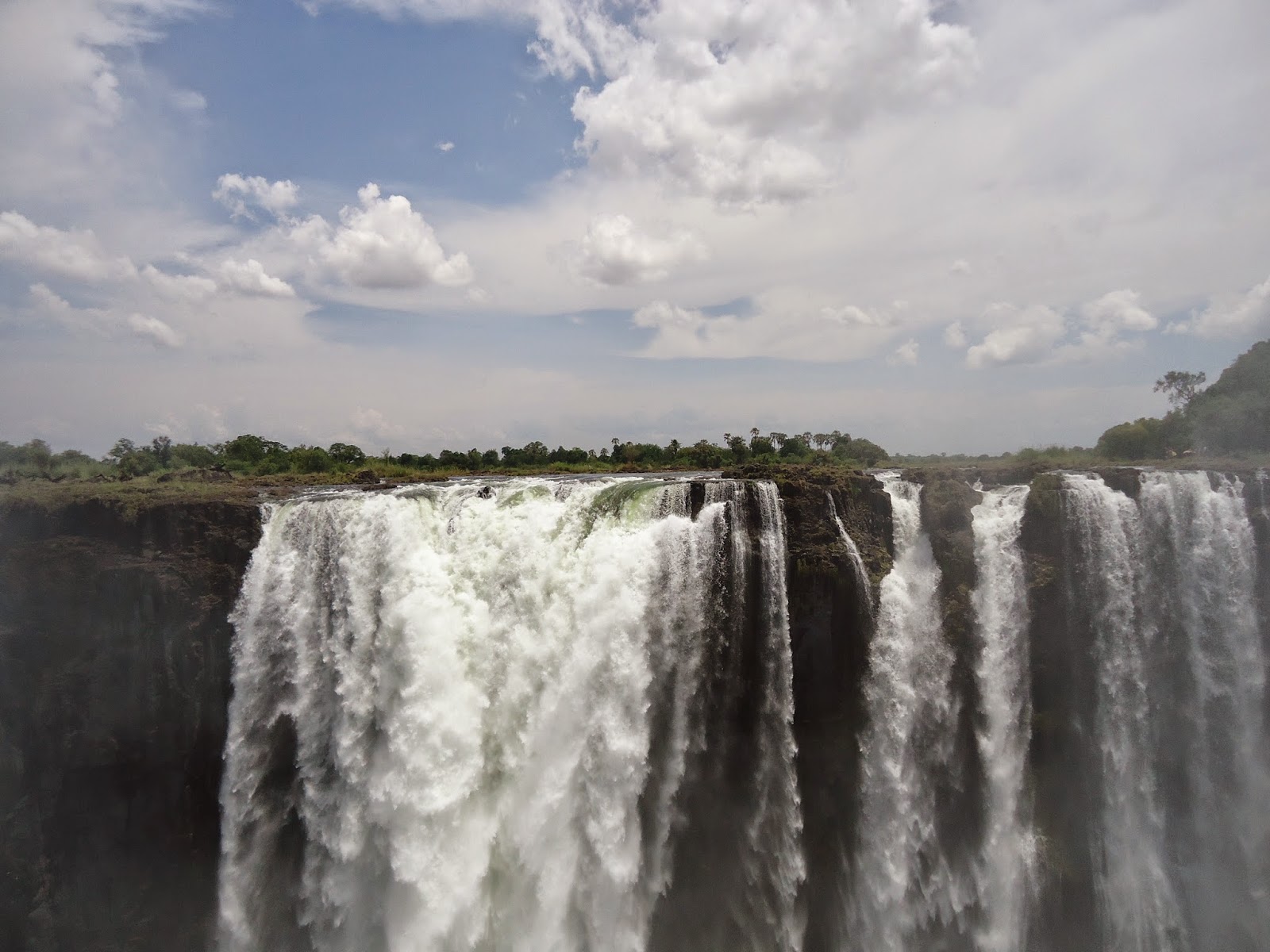
the first viewpoint
Victoria Falls brought me to tears. It is so crazy beautiful that I could not help lingering at the many viewpoints, and (when there weren’t too many other tourists around) literally yelling about how amazing it is. I had to hold my head on because it was about to float away from me and drop down the cliff with those waters. I settled to imagine I was any one of the dragonflies or sparrows darting over the edge and into the gorge.


I visited the Zimbabwe side. This has the best views of the falls. If you visit the Zambia side, you can actually go in the water right at the edge where a natural “armchair” formation called Devil’s Pool allows you to sit right at the crest of the waterfall. I watched some crazy people do this. Someday when I come back, I’ll try it myself.


the Main Falls at low water

Devil's Pool at the edge of the Main Falls

There are 16 viewpoints along the walk, stretching from the statue of Livingstone overlooking the Zambezi near Devil’s Cataract to the Main Falls, then further along the gorge to Horseshoe Falls, Rainbow Falls and the Eastern Cataract. It’s a few kilometer walk with areas near the main spray that are thick like rainforest down to bare basalt rock in the driest portions near Rainbow Falls.


The Main Falls
Victoria Falls is also called Mosi-oa-Tunya, “the smoke that thunders.” It overwhelms the senses. I’m told that during high water in April and May, you can’t even see the water for all the clouds of vapor rushing off the rocks as the falls plummet and crash. But, now in December, it’s low water. The falls are not continuous, but separated into distinct portions around the island rivers. In some portions you can see the basalt cliffs behind the water. I was amazed to see lichen growing on them. What an incredible survivor.


It is no surprise that this place is one of the Seven Wonders of the World. It’s exquisite and ferocious. It steals my words and flings them hundreds of feet down into white and green froth, soaking them for a moment in perpetual rainbows.


What drives me the most absolute out of my mind with thrill for waterfalls is that they are never the same. (Ok--sure, that’s true of everything if you want to get esoteric. But bear with me.) Each surge of water, if you can separate the continual outpour, is a different compilation of droplets, molecules, etc. Even though it looks like a solid sheet of water, you can watch each distinct portion as it moves from the edge down back to become river again. For a moment, it is purely suspended in freefall.
Horseshoe and Rainbow Falls


I wonder what it feels like as it falls. I do not aim to find out in this lifetime. Of course, a rare hippo, crocodile or clumsy tourist does go over the edge and is smashed to bits at the bottom, sometime recovered in the Boiling Pot downstream.


Perhaps the pictures do a better job of describing the experience than I have in writing. The water itself tells the best story though, and I urge you to come listen to it for yourself. We could even come back together.


With love,

Carrie

me at the Main Falls

Kasane


elephants in Chobe National Park
I went to Kasane without any real plans. Said I’d figure it out when I got here. But it's all worked out wicked well. I got lucky that, out of all the phone numbers I called, the most affordable one was the only one with a room available. My home this week is run by some of the most helpful people I’ve yet met.


My accommodations here in Kasane have been Bophirimo Guesthouse run by Kebonye and Simon. They have helped to connect me with the folks who run the Chobe Snake Park, a local geologist and literature aficionado, and best of all, two local writers: Peter Comely, a safari guide and novelist, and very accomplished poet Onalethuso Petruss Ntema. Meeting these two has been very inspiring. And they both signed copies of their books for me. (Score!)These are the connections I look for. Serendipity is a real blessing.


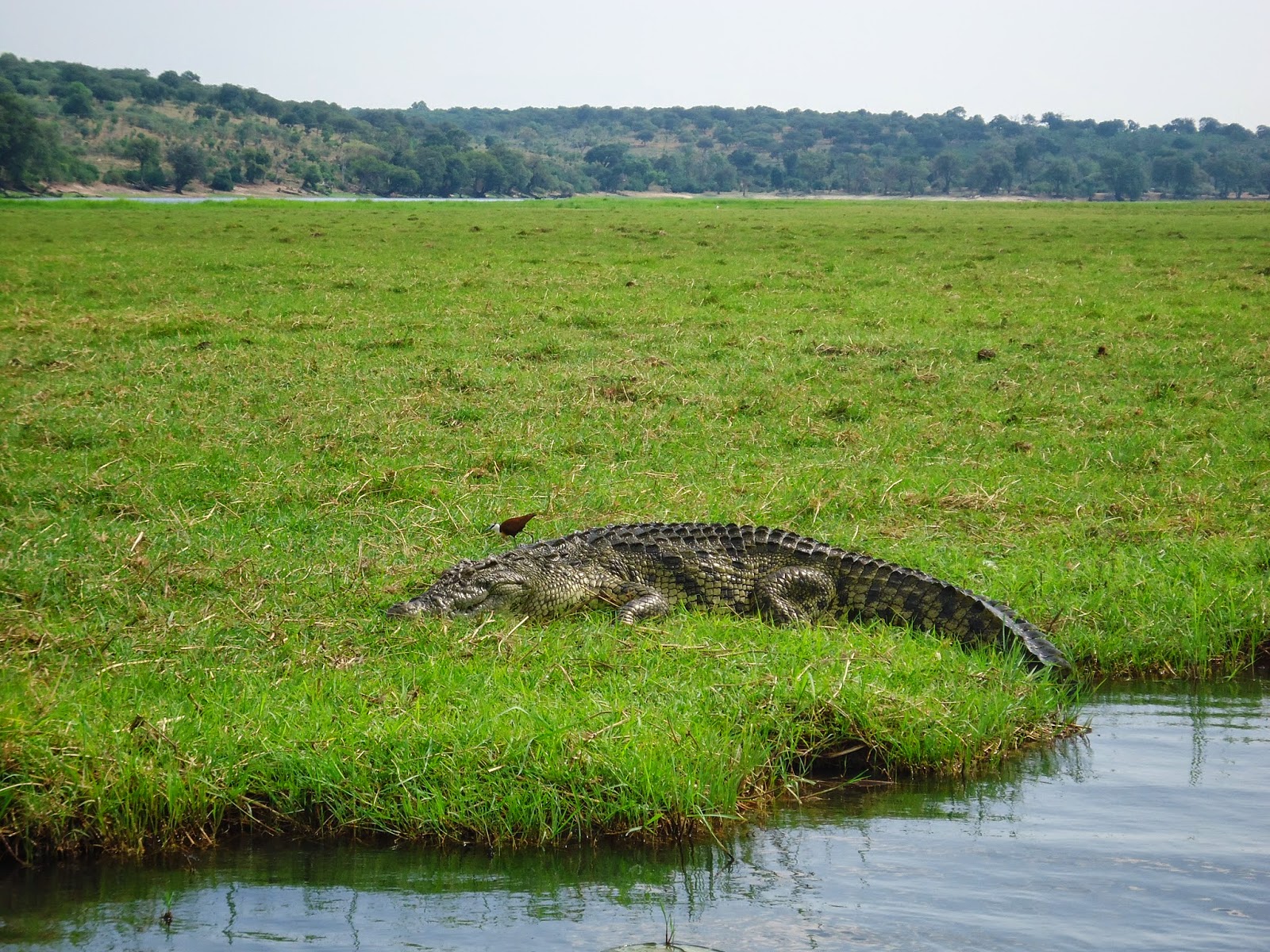
crocodile on Sedudu Island between Botswana and Namibia
I’ve visited the Caprivi Strip in Namibia, crossing the convergence of the Chobe and Zambezi Rivers to play a homemade marimba and watch pied kingfishers, crocodiles, and hippos along the riverbank. The reeds on the island in the middle of the river had been mown flat by the local herds of elephants.


I visited the Chobe Snake Park and Biodiversity Centre where they keep a variety of snakes and other rehabbed wildlife. Some were local captures, others were recovered from smugglers, or found injured by poison or car-strikes. I got to hold pythons, brown house snakes, and beaked snakes. I kept my distance behind the glass from the puff adders and black mamba, admiring these deadly creatures.


Chobe is elephant territory
Best of all, the staff at the Snake Park let me tag along to help with some of their research projects. That turned out to be an extraordinary day. Someone had called in a report of an injured white-backed vulture. This individual seemed to be poisoned, potentially by Rat-X. With the proper permit clearance from the wildlife department, the vulture, dubbed Jiles, was brought back to the centre for food and water and some charcoal tablets to help absorb the poison. Latest I've heard is that he's doing well and soon to be released.


I helped with a community study of diseases carried by flies and got to talk the similarities between scientific and literary journals, the effects of poaching and anti-poaching efforts, local culture, and as they say here: all the what-what. Shop shop [Ok]. It was a great opportunity, plus he blogs about his experiences working in conservation, which is very affirming to me in my search for the connections between conservation and writing.


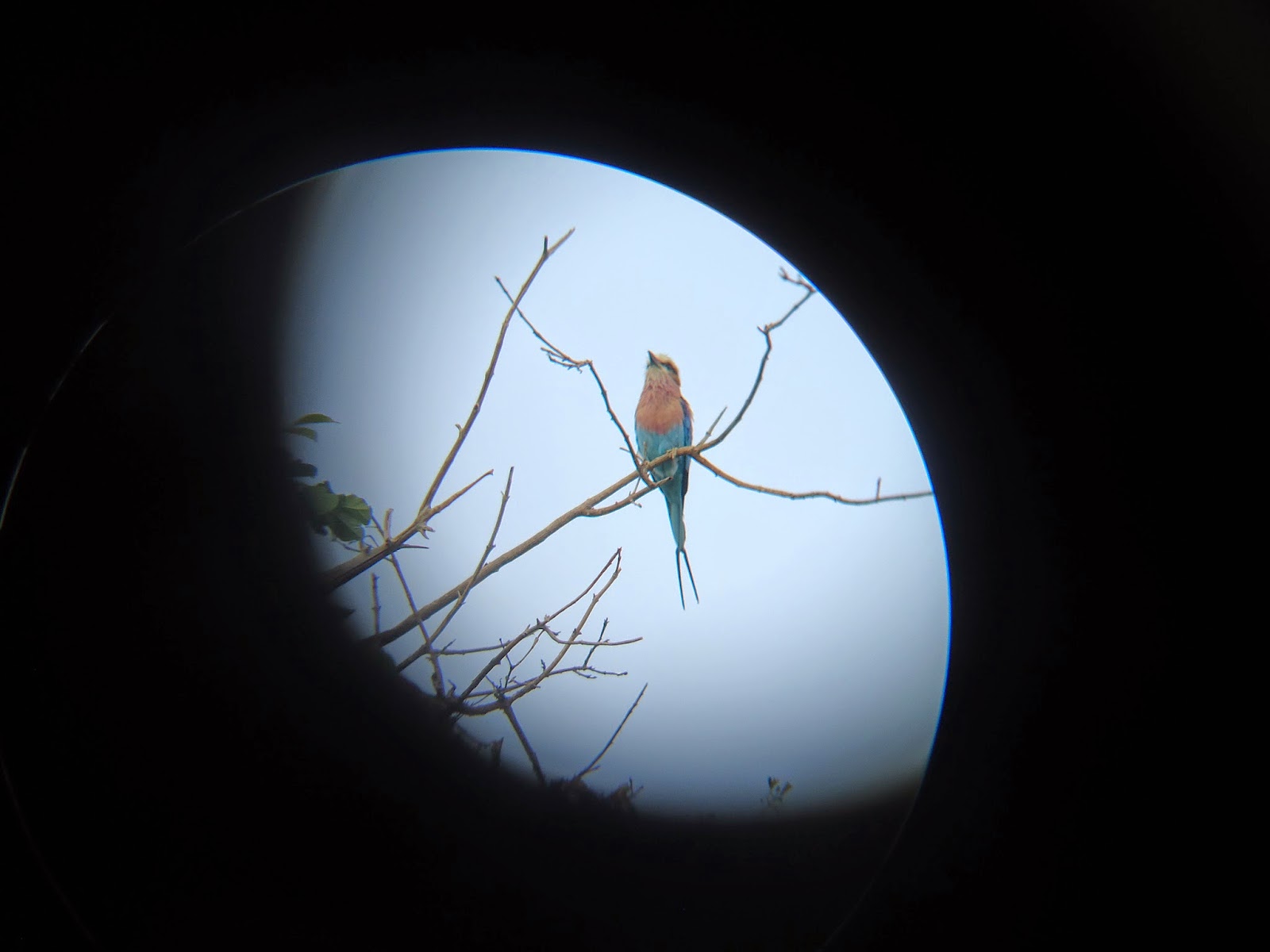
Lilac Breasted Roller
I also got to visit Victoria Falls, but that’s going to be a blog entry of its own. I hope to return to Kasane someday. I’ve loved it here, and highly recommend Bophirimo Guesthouse to you when you come.


Next time I see you, ask me about the night on the wildlife corridor when I stood in a herd of elephant. Ahemdullah.


Love,
Carrie  
big ol bull elephant (guess how you can tell)


Khama Rhino Sanctuary

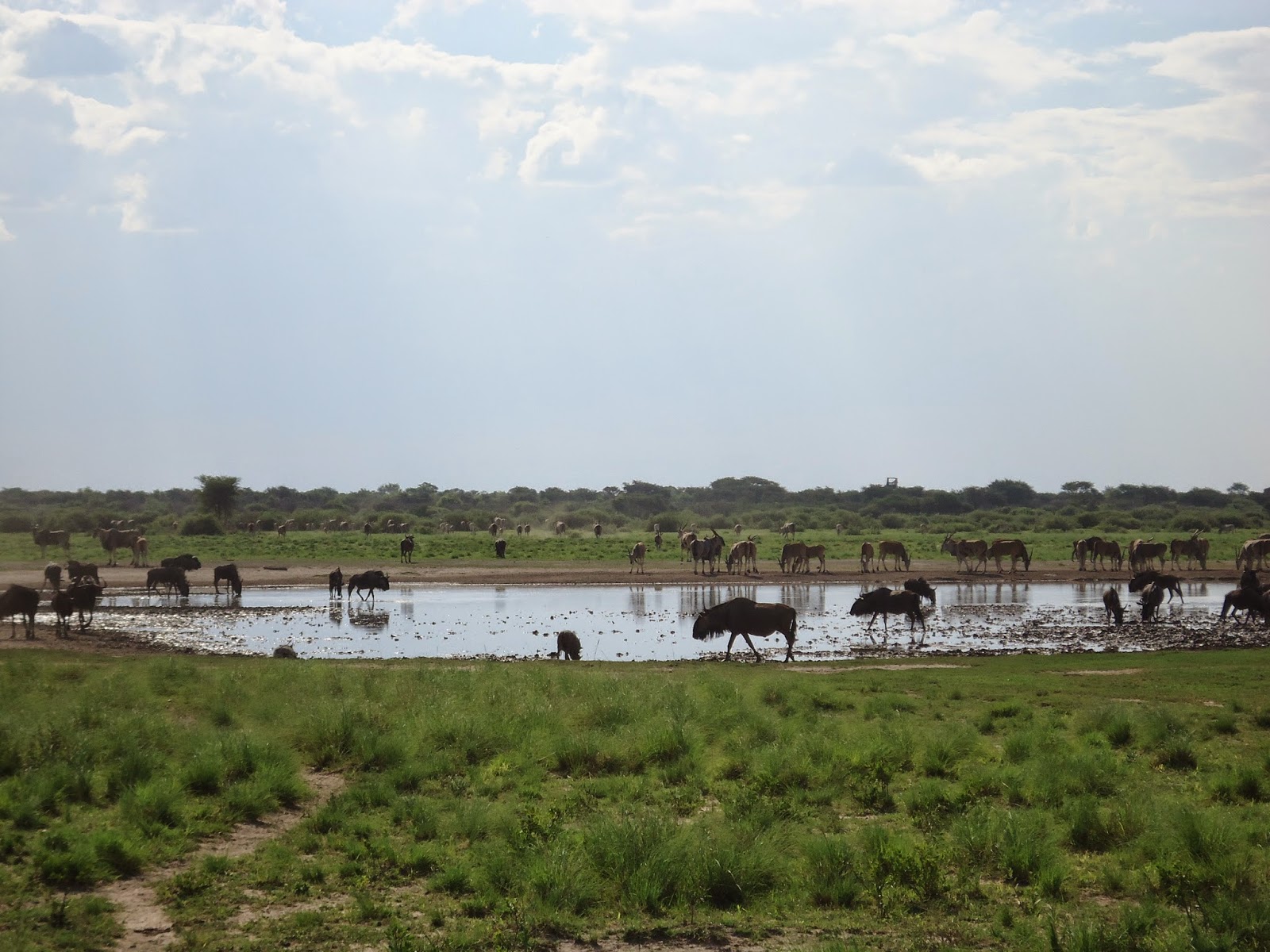
zebra and wildebeest at the pans


My major nature conservation work here in Botswana has been at Khama Rhino Sanctuary. I came in through the Botswana Workcamp Association, which was the most feasible way for me to volunteer in the sanctuary. I was there for two weeks at the end of November and returned in December for another two week stint.


Khama Rhino Sanctuary entrance
Khama Rhino Sanctuary is a non-profit community based conservation organization operated by the three neighboring villages of Serowe, Paje, and Mabeleapudi. It’s about 8500 hectares of protected land intended primarily to conserve the white rhino and black rhino populations, though there’s tons of other wildlife as well. There’s a perimeter fence which keeps animals in (most of the time) and poachers out (ideally). Both are capable of breaking through, like the pair of sparring kudu who crashed through several fenceposts one day during my time there. But the fence certainly makes one question the real definition of “wild.” Which is just what I’m supposed to be doing. It’s one of the major questions of my fellowship year.


But, this is supposed to be a travel blog, and I’m reluctant to post my yet-unarticulate philosophic mumbo-jumbo here. I want to tell you more about the rad things I’ve been doing.


I’ve been seeing so many animals that I never expected to see in real life, as well as (to be perfectly honest) some that I’d never even heard of before. In a lot of ways, this year is revealing so much of my ignorance and exposing me to listen to new stories, new ideas, new lifestyles, and new life histories. Nearly every day at Khama Rhino, on the drives between our campsite in the bush and our worksites at other places in the bush, I saw wildlife.


White Rhinos
Zebra, wildebeest, impala, warthog and white rhino were a nearly daily sight. I saw giraffe, kudu, eland, spring hares and springbok less commonly. The rarest sightings were a tortoise, chameleon, spotted hyena, jackal, and the crown jewel, a young leopard. Alas I didn’t always have my camera handy, but I felt incredibly blessed to witness these animals in the flesh in their real lives.


And I haven’t even mentioned the birds! Perhaps I’m listing too many things in this blog, but my life is flooded with all these amazing creatures. My heart is the ark and we’re set sail for far longer than forty days. Some of my favorite birds to see so far were the Maribu Storks (considered one of the Ugly Five that juxtapose Africa’s Big Five animals), Yellow-billed Kite, Go-away Bird (Grey Lorrie), and Crimson-breasted Shrike. Even the common Cape Turtledove that sings Bot-tswaaa-na Bot-tswaaa-na.

Giraffe
I’ve also seen so many neat bugs! Praying mantises have become my dear friends here. They are just too cool with all their different varieties. They all seem to love landing on me and climbing all over my arms and under my collar. It’s a bit tickly, but it feels like a blessing. The dung beetles zip across the pans at a zillion miles an hour and look like little hulks when they walk on land, deflty pushing balls of scat backwards in front of them.


The actual work at Khama Rhino often felt tangential to the wildlife, but I’m learning about how these tasks relate to the work of conservation overall. The people I met were an interesting mix of true nature lovers passionate about wildlife and others who liked wildlife but saw their involvement at the sanctuary as merely a job. Perhaps they’d rather be a nurse of a teacher or a taxi driver, but there’s work available here. Conservation is a business, and there are a lot of stakeholders.


After working, we cooked everything by open fire and I became good friends with the other volunteers as we chatted late into the night by the fireside. Fires and rivers and animals. I could watch them all forever.


More soon.


Love,
Carrie


firewood collection in the pick up truck selfie